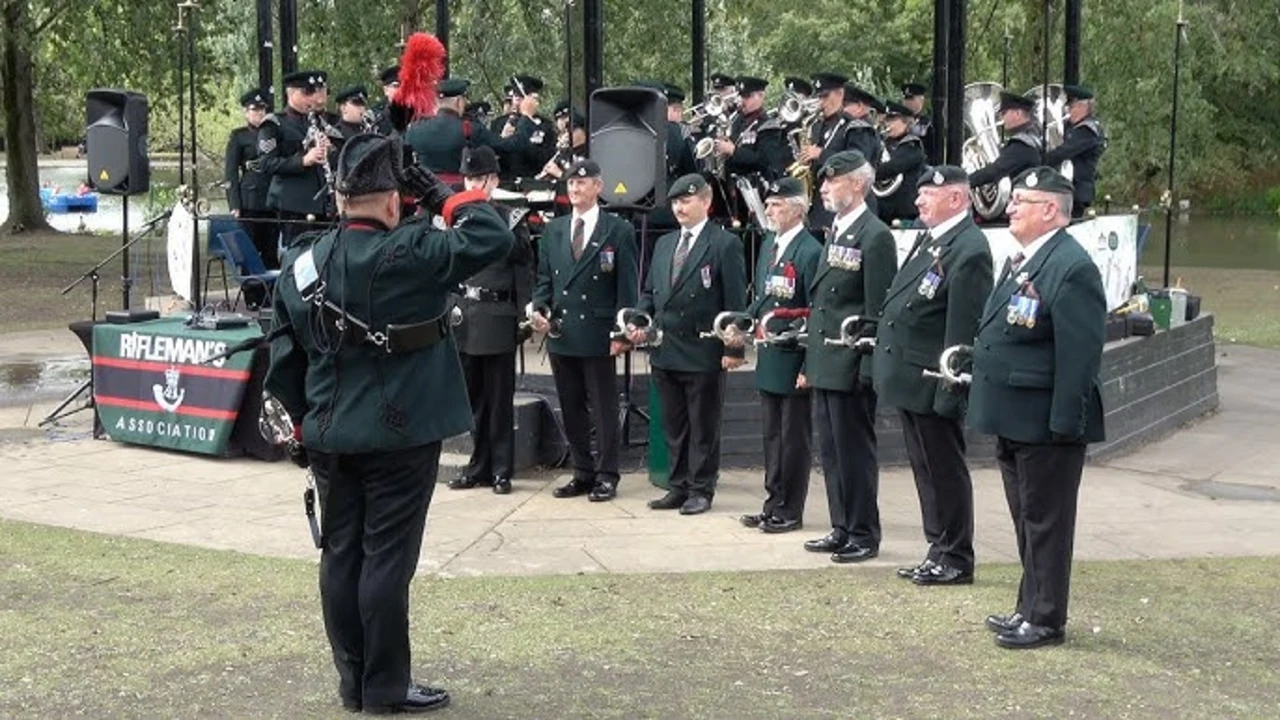
For a regiment that formally existed for only four decades, the royal green jackets regiment casts a long shadow. Its name still turns up on memorials, in family stories, and in the habits of soldiers who never stopped thinking of themselves as riflemen. It also survives in British military culture more broadly: in the idea of light infantry that moves quickly, fights with initiative, and treats discipline as something internal rather than imposed by ritual.
To understand the regiment properly is to understand two things at once. First, that it was a modern creation, born in the administrative reshaping of the British Army after empire. Second, that it carried a lineage older than most institutions in the country, drawing on the traditions of the Rifle Brigade, the King’s Royal Rifle Corps, and the Oxfordshire and Buckinghamshire Light Infantry. The result was a regiment that looked contemporary on paper but lived and fought as the heir to a distinctive way of soldiering.
The question many people ask is simple: what exactly was the royal green jackets regiment, what did it do, and what happened to it? The answers sit at the intersection of history, identity and hard military necessity.
The rifle tradition: why “green jackets” meant something
Long before the term “light infantry” became standard, Britain developed specialised troops trained to fight differently from the line infantry that dominated European battlefields. The classic image of the eighteenth-century soldier is the red-coated infantryman moving in tight formations, firing volleys at short range. Riflemen were a challenge to that model.
Rifles, unlike smoothbore muskets, were more accurate at distance but slower to load. That trade-off made sense if you used small groups, aimed shots and cover, rather than massed fire. Riflemen needed to think for themselves, read ground, and act with a degree of independence that traditional drill did not encourage. They also needed to blend into the landscape. That is where the green jacket comes in. Green was not a fashion choice; it was a practical response to the idea of concealment and skirmishing.
By the time the Napoleonic Wars made riflemen famous, the British Army had developed units that were defined by this ethos. The 95th Rifles, immortalised later in novels and television, and the 60th Royal Americans (later the King’s Royal Rifle Corps) established a reputation for speed, marksmanship and unconventional tactics. Their influence was not only tactical. It created a culture: less reliance on drums and parade-ground theatre, more emphasis on competence and initiative.
That culture would shape every descendant formation, including the royal green jackets regiment. Even when the Army mechanised, even when operations shifted from European battlefields to counter-insurgency and peacekeeping, the idea of the rifleman remained central: a soldier trained to act quickly, to use judgement, and to work in smaller, flexible groups.
From old regiments to one name: the road to 1966
The royal green jackets regiment was formed in 1966, but it did not appear out of nowhere. The years after the Second World War were a period of significant contraction for the British Army. National service ended, imperial commitments receded unevenly, and governments demanded leaner structures. Amalgamations became routine.
In 1958, the Army grouped three regiments into the Green Jackets Brigade: the Oxfordshire and Buckinghamshire Light Infantry, the King’s Royal Rifle Corps, and the Rifle Brigade. The brigade was an attempt to keep identity and recruitment stable while preparing the ground for deeper change. It also reflected a recognition that these units shared a common rifle heritage, even if their individual histories were fiercely guarded.
Eight years later the inevitable happened. The three regiments were formally amalgamated into a single large regiment, the royal green jackets regiment, initially with three regular battalions that directly reflected the old order. The 1st Battalion traced its immediate roots to the Oxfordshire and Buckinghamshire Light Infantry, the 2nd Battalion to the King’s Royal Rifle Corps, and the 3rd Battalion to the Rifle Brigade.
This mattered because large-regiment structures are as much about manpower management as they are about tradition. A larger administrative umbrella makes it easier to move soldiers between battalions, to smooth recruitment and posting, and to absorb future cuts. It can also, if handled badly, flatten identity. The royal green jackets regiment tried to do the opposite: to treat the rifle tradition as a shared language, strong enough to carry everyone without erasing what came before.
What the regiment did: battalions in a Cold War Army
To ask what the royal green jackets regiment “did” is to ask what a British infantry regiment did from the mid-1960s to the mid-2000s. The answer is not one war but a succession of roles: deterrence in Europe, tours in Northern Ireland, overseas garrisons, and later the patchwork of peace support operations and expeditionary campaigns that defined the post-Cold War era.
During the Cold War, a substantial part of the British Army’s effort was committed to the British Army of the Rhine in West Germany. Infantry battalions trained for a war that everyone hoped would not happen, working within armoured and mechanised formations, practising rapid reinforcement, and learning to operate under the shadow of escalation. This was a different form of soldiering from the romantic idea of skirmishers in green, yet the rifle ethos still had a place: speed, initiative and disciplined fieldcraft mattered as much in the forests and training areas of Germany as they did anywhere else.
At the same time, Britain maintained overseas garrisons and met recurring security commitments. The late imperial period and its aftermath were marked by emergencies that demanded infantry: internal security operations, protection of strategic sites, and deployments that blurred the line between policing and war. The regiment’s predecessors had deep experience of that world; the royal green jackets regiment inherited it and continued it, learning the unglamorous craft of patrolling, intelligence gathering, and restraint under provocation.
The breadth of this work is one reason the regiment’s history can be hard to summarise. There is no single “RGJ war” in the public imagination. Instead there are decades of soldiering that rarely became headline news but shaped the Army’s methods and the lives of thousands of service personnel and families.
Northern Ireland: the defining domestic deployment
For many soldiers of the period, Northern Ireland was the most demanding and morally complicated operation of their careers. Operation Banner, which ran from 1969 to 2007, required repeated infantry tours, and rifle regiments were heavily involved.
Northern Ireland was not conventional warfare. It was an environment where the soldier was always visible, always judged, and often targeted. Patrols took place among civilians whose lives were constrained by fear and politics, and where the presence of the Army could be simultaneously protective and inflammatory. Decisions made in seconds could have strategic consequences.
The royal green jackets regiment, like other infantry regiments, had to adapt to this reality: tight rules of engagement, close coordination with police, and constant attention to the information battle. The skills that riflemen valued, such as fieldcraft and initiative, were useful, but they were not sufficient on their own. The Northern Ireland environment demanded discipline of a different kind: emotional control, cultural awareness, and an ability to operate under scrutiny.
It also left scars. Casualties occurred, and the strain of repeated tours affected families and communities. Any serious account of the regiment must acknowledge that, while avoiding the false simplicity of treating the conflict as either a straightforward military success or failure. For soldiers, it was often neither. It was a long, ambiguous commitment that shaped a generation’s understanding of what the Army could and could not do.
From peacekeeping to expeditionary war: the post-1990 deployments
The end of the Cold War did not bring a quieter Army; it brought a more unpredictable one. British forces were deployed to the Balkans in the 1990s, to enforce fragile peace agreements and protect civilians in a landscape still raw with violence. Infantry units found themselves running checkpoints, escorting convoys, separating armed groups and trying to maintain legitimacy in communities that distrusted every uniform.
Those operations demanded patience and judgement, and they also demanded the ability to switch quickly to force when necessary. They suited certain aspects of the rifle tradition: small-unit confidence, careful movement, and soldiers trained to think. But they also exposed the limits of infantry power when political solutions lagged behind.
After 2001, the rhythm changed again. Afghanistan and Iraq became long-running commitments that required repeated tours, heavy adaptation and, in many cases, close combat in complex terrain. By then, the royal green jackets regiment was nearing the end of its independent existence, but its battalions were part of that era of operations, shaped by the same pressures as the rest of the infantry: improvised explosive devices, the strain of multiple deployments, and the challenge of fighting insurgencies while trying to build durable local security.
It is important not to overstate a single regiment’s uniqueness in this period. Many units did similar work. The point is that the royal green jackets regiment spanned a period in which the British infantry’s task shifted from preparing for major war in Europe, to managing internal security at home, to complex expeditionary campaigns abroad. Few regiments had a timeline that captured so much of modern British military history so directly.
Traditions that mattered: how rifle regiments are different
The royal green jackets regiment belonged to the rifle family, and that meant its daily culture diverged from what many people imagine when they picture the British Army on parade.
Rifle regiments traditionally do not carry colours in the way line infantry regiments do. That is not a rejection of tradition but a different tradition: riflemen historically operated dispersed, without a colour party at the centre of a formation. Their identity was carried instead in badges, titles and the shared language of the regiment.
Music and signalling were also distinctive. Bugles, rather than drums, were central to rifle regiments, reflecting the practical need to pass commands across broken ground. The idea of the bugle call is more than pageantry; it is the echo of a tactical doctrine.
Even marching pace has its symbolism. Rifle regiments are known for moving quickly, a “double past” that expresses the idea of speed and urgency. It can look theatrical to outsiders, but it is rooted in the image of light troops expected to cover ground fast.
Then there is the language. A private soldier in a rifle regiment is a Rifleman, not a Private, and that small change carries a sense of craft. The emphasis is on competence: shooting, movement, field discipline, and the expectation that soldiers will understand why they are doing something, not merely how.
Uniform traditions, including the association with rifle green, bind this together. The name “Green Jackets” itself speaks to a continuity that soldiers and veterans recognise immediately, even if civilians only half-understand it.
These customs were not ornaments. They were part of how the regiment built cohesion across battalions and across generations, especially important in a large regiment formed from three older units.
Battle honours and inherited memory
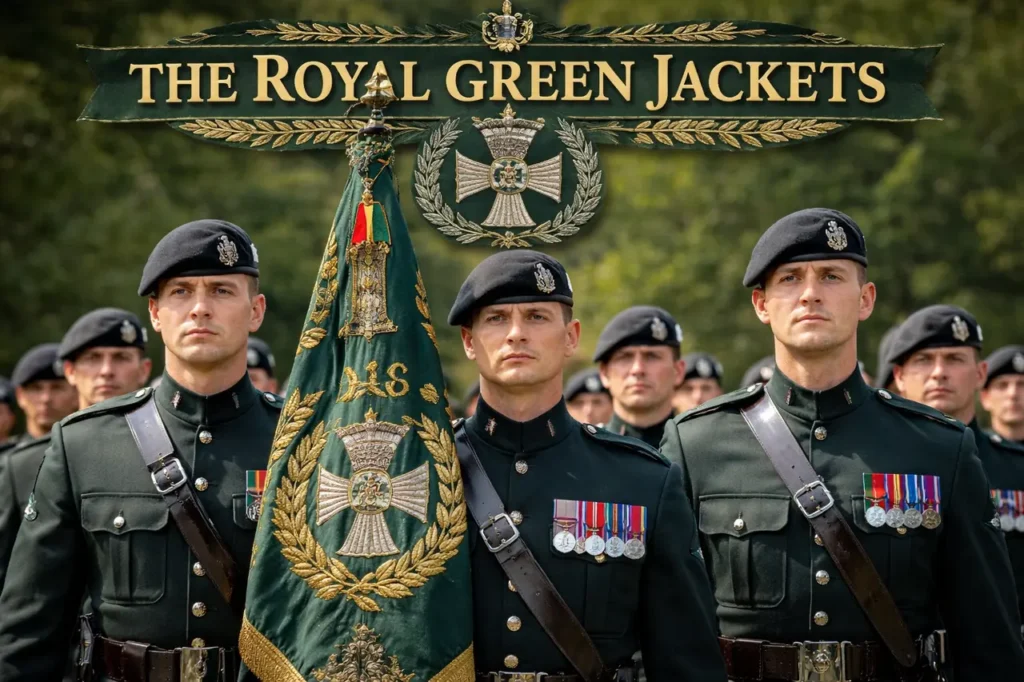
The royal green jackets regiment inherited battle honours that reached back through centuries. That inheritance is one reason it attracted such loyalty. Soldiers joining in the 1970s or 1980s were not simply joining a new administrative construct; they were joining a chain of stories that included some of the Army’s most storied campaigns.
One strand ran through the Napoleonic period and the development of rifle tactics. Another ran through imperial wars, for better and for worse, reflecting Britain’s global history. A third included the world wars, including the airborne heritage of the Oxfordshire and Buckinghamshire Light Infantry, most famously associated with the capture of the bridges on D-Day at what became known as Pegasus Bridge.
These layers are not always easy to reconcile. Regimental history can be a source of pride, but it also raises questions about how Britain remembers its past. A mature view of the regiment recognises both: the professionalism and bravery of soldiers in their own time, and the fact that some campaigns were fought in the service of an empire whose legacy is contested.
Within the Army, battle honours are not primarily about politics; they are about continuity and the moral obligation to live up to a standard. For the royal green jackets regiment, that standard was bound up with the rifleman’s self-image: skilled, quick, and quietly confident.
The end of the name: amalgamation into The Rifles
In 2007, the royal green jackets regiment ceased to exist as a standalone regiment when it became part of The Rifles, a new large regiment formed from several light infantry and rifle regiments. This was another round of restructuring, driven by manpower needs and a strategic view that the Army required fewer, larger administrative entities.
The transition did not erase the Green Jackets identity, but it changed how it was housed. The two remaining RGJ regular battalions became battalions within The Rifles, carrying forward their lineage and many of their customs under a broader title. For veterans, this can feel like a loss of a name that carried personal meaning. For the Army, it was presented as continuity through evolution: preserving traditions while creating a structure judged better suited to the demands of modern service.
The key point is that the regiment did not “disband” in the sense of vanishing. Its people, customs and inherited history continued, but under a different cap badge.
Conclusion: what the royal green jackets regiment represents now
The royal green jackets regiment is best understood as a bridge between eras. It carried forward a rifle tradition born of skirmishing and marksmanship into a world of mechanised deterrence, urban patrolling and expeditionary war. It was a product of modern Army reform, yet it lived on the strength of older identities that refused to be reduced to a bureaucratic label.
For those who served, the regiment was not an abstract lineage; it was a way of doing the job, a set of expectations about speed, initiative and professionalism. For the wider public, it is a reminder that British military history is not only the story of famous battles. It is also the story of institutions adapting, absorbing change, and trying to keep hold of what makes them coherent as the world around them shifts.
The name no longer appears on the Army’s current order of battle, but it remains present in living memory and in the culture of the rifle regiments that followed. In that sense, the royal green jackets regiment is not simply a chapter closed in 2007. It is a continuing influence, carried forward by those who still call themselves, first and last, riflemen.