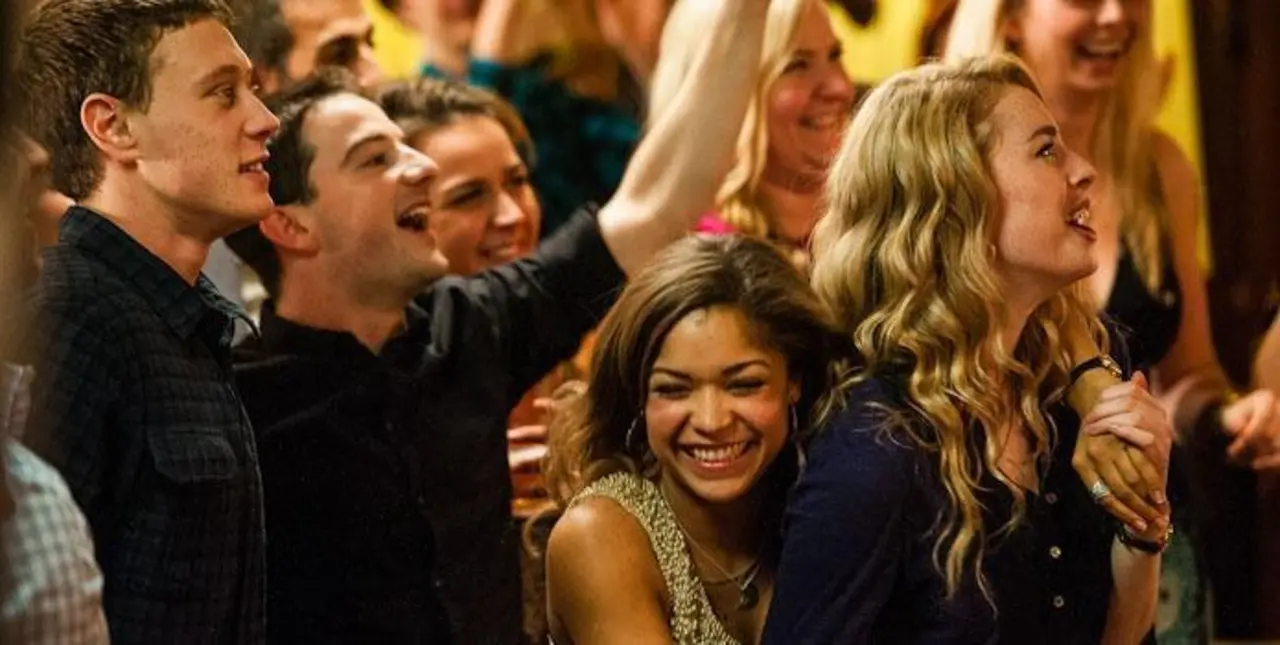
When Actors in Sunshine on Leith arrived in cinemas in 2013, it came trailing two sets of expectations. One belonged to The Proclaimers’ songs, which had long since escaped the category of “band” and become part of Britain’s informal songbook, sung at weddings, football grounds and late-night pubs with an affection that can’t be faked. The other belonged to the stage musical that had already proved the concept: that these anthemic, plain-spoken tracks could be stitched into a story rooted in modern Edinburgh, with love, friendship, family tensions and the aftershocks of military service.
Turning that into a film was never going to be a matter of simply pointing cameras at a theatre production. Cinema demands a different register. Close-ups punish overstatement; real streets and real skies make stagey sentimentality look thin. That is why the actors in Sunshine on Leith matter so much. In a jukebox musical, the songs are pre-sold. The cast must do the harder work of persuading you that characters would sing them, here, now, without the whole thing collapsing into a compilation album with dialogue attached.
People searching for actors in Sunshine on Leith are often looking for the straightforward answers: who plays whom, where have they seen them before, which performances stand out. But the more revealing story is how this particular ensemble was built, and how their varying backgrounds in film, television and theatre shaped the tone. Sunshine on Leith is, in essence, a film that tries to feel local without being parochial, emotional without becoming syrupy, and musical without losing its footing in everyday life. Its casting choices are the hinge on which all of that turns.
From stage to screen: why this musical needed a specific kind of cast
Sunshine on Leith began life as a stage show in Scotland, where audiences were already primed to hear their own lives reflected in popular music: the patter of working life, the stubborn humour, the bruised loyalty to place. Dexter Fletcher’s film adaptation keeps that intention, but it also has to translate it for viewers who may not know Leith beyond a football chant or a postcard view of Edinburgh’s Old Town.
That translation isn’t just scenic. It is human. A film version can’t rely on the audience’s goodwill towards theatre conventions; it has to earn credibility moment by moment. The cast therefore needed to manage a difficult balancing act: present the heightened emotion required by musical storytelling while staying grounded enough for a contemporary romantic drama.
The film’s central quartet—two young men returning from military service and the women they love—had to feel like people you might actually pass in a supermarket queue, rather than performers waiting for their number. Around them, the older characters needed the weight of lived history, because Sunshine on Leith isn’t only a story about young romance; it is also about secrets, regret, and the ways families tell themselves comforting stories until circumstances force the truth out.
It’s worth remembering, too, that The Proclaimers’ writing has a particular moral texture. These songs can be rousing, but they are rarely glossy. They sit comfortably with vulnerability, with self-knowledge, with the awkwardness of love declared too plainly. That tone demands performers who can act through a lyric without “musical theatre-ing” it to death. The best singing in Sunshine on Leith is not necessarily the most technically perfect; it is the most believable.
George MacKay as Ally: restraint, awkwardness and the problem of coming home
George MacKay plays Ally, one of the two soldiers at the heart of the film. MacKay’s screen presence has often been defined by intensity held in check; even when his characters are emotionally loud inside, the performance tends to stay controlled on the surface. That quality becomes an asset in a musical that tries to keep its feet on the pavement.
Ally returns to Edinburgh carrying the unspoken tension that the film never treats as an accessory. The story does not present military service as a convenient bit of drama; it is part of the characters’ psychology and their bonds. MacKay plays Ally as someone who is trying to slide back into ordinary life without drawing attention to how difficult that is. In a non-musical, the same character might turn inwards and become inaccessible. In Sunshine on Leith, he has to remain open enough for songs to do their work.
That is where the film’s casting becomes interesting. MacKay is not, in the obvious sense, a “big musical personality”. He does not dominate scenes through comic flourish or vocal showmanship. Instead, he gives the film a centre of gravity. He makes the quieter moments count, which is essential because musical numbers land harder when the spoken scenes feel real.
As for the singing: the approach is generally in keeping with the film’s aesthetic. You are not watching a polished, Broadway-style vocal showcase. You are watching a character sing songs that, in British culture, often exist as communal chants. That is a different job. It’s about phrasing, honesty, and the ability to carry a melody without sounding like you are auditioning.
Paul Brannigan as Davy: charisma, humour and the film’s emotional engine
If MacKay supplies restraint, Paul Brannigan supplies propulsion. Brannigan plays Davy, Ally’s friend and fellow soldier, and his energy gives the film much of its forward motion. Brannigan has a recognisable skill for combining cheekiness with vulnerability, allowing a character to be funny without becoming a cartoon. In a musical that risks tipping into whimsy, that human roughness matters.
Davy is the sort of character who can steer scenes away from solemnity, but Sunshine on Leith also asks him to be more than the mate with the one-liners. The romantic storyline, the loyalty between friends, and the shifts in identity that come with returning home all run through him. Brannigan plays those changes with an ease that feels unforced, which is precisely what you want when people are about to break into song on a city street.
The film’s tone depends on the sense that these young men have a history together. That has to be acted; it can’t be scripted into existence. Brannigan and MacKay create a believable friendship by allowing silences and small irritations, not just performative banter. It is one of the reasons the film’s emotional turns don’t feel entirely pre-programmed.
When people ask about actors in Sunshine on Leith, Brannigan’s name often comes up because he embodies something the film needs: a distinctly Scottish screen presence that is contemporary, not tartan nostalgia. The setting is Edinburgh, not a museum of Scottishness, and Davy helps keep it that way.
Freya Mavor as Liz: modern romantic lead, not a sentimental cipher
Freya Mavor plays Liz, Ally’s partner. In many jukebox musicals, female leads are placed in the story chiefly to receive songs—beautifully lit conduits for the soundtrack. Sunshine on Leith makes a stronger attempt to give Liz agency, and Mavor’s performance is part of why it works as well as it does.
Mavor has the ability to read as intelligent and watchful, which is crucial for a character who has to respond not only to romantic disappointment but also to the subtler dislocations of loving someone who has been away to war. Liz is not written as a simple object of yearning; she is a young woman with family ties and expectations pressing on her, and Mavor plays those pressures without melodrama.
What stands out is how she navigates the film’s shifts in mode. Musical numbers can easily turn a character’s feelings into declarations that look too neat. Mavor’s Liz keeps some messiness around the edges. She can be affectionate and irritated in the same breath, and she doesn’t soften her reactions purely for audience comfort. That gives the romance a more contemporary texture, less fairytale and more recognisable.
In terms of singing, Mavor’s voice fits the film’s preference for character-led vocals rather than theatrical perfection. The songs in Sunshine on Leith often work best when they feel like extensions of speech, and she shapes lines with that sensibility.
Antonia Thomas as Yvonne: warmth under pressure, and a different energy to Liz
Antonia Thomas plays Yvonne, Davy’s partner. The film is careful not to treat the two women as interchangeable romantic fixtures, and Thomas brings a different quality to her scenes: a mixture of warmth and steeliness, the sense of someone who has already decided that love is not only about emotion but about choosing to stay.
Thomas was already familiar to audiences through television work that demanded comic timing and emotional clarity. That combination serves Sunshine on Leith well. Yvonne needs to be engaging quickly; the film doesn’t have endless time to build her backstory in detail, so the actor has to communicate stability, affection and frustration with efficiency.
The romantic dynamics also depend on contrast. Liz and Ally’s relationship carries a certain cautiousness, shaped by what Ally has experienced and what he withholds. Yvonne and Davy are more outward, more openly physical and expressive. Thomas helps establish that difference without making it feel like a simplistic “sensible couple versus dramatic couple” split.
If the question is what the actors in Sunshine on Leith contribute beyond singing familiar songs, Thomas is a good example. She makes Yvonne feel like someone who exists outside the musical’s machinery. Even when the plot pushes her into heightened moments, she retains a sense of personal logic, which is essential for keeping the film’s emotional stakes credible.
Kevin Guthrie as Rab: comedy with bite and the importance of the third friend
Kevin Guthrie plays Rab, the friend who completes the trio around Ally and Davy. In many ensemble stories, the “other mate” exists to deliver jokes and then fade into the background. Sunshine on Leith gives Rab more to do than that, and Guthrie’s performance helps prevent the film becoming a neat two-couple romance with spare parts.
Guthrie has a knack for making humour feel like social currency rather than performance. Rab’s jokes are not there to entertain an audience; they are there to manage feeling—his own and other people’s. That is a distinctly real function of humour in close-knit communities, and it sits well with the film’s working- and lower-middle-class milieu.
Rab also provides tonal insurance. Jukebox musicals can become emotionally one-note if every scene is either romantic yearning or big life revelation. Rab’s presence allows for a rougher, more laddish energy, but Guthrie avoids making the character purely laddish. There is sensitivity under the bravado, and when the story calls for it, he can turn serious without the shift feeling like a switch has been flicked.
For viewers interested in actors in Sunshine on Leith, Guthrie is part of what makes the film feel like an ensemble rather than a star vehicle. He helps populate the world beyond the central love stories, which is vital if Edinburgh is to feel like a lived-in city rather than a scenic backdrop.
Jane Horrocks as Jean: the emotional core and the risk of sincerity
Jane Horrocks plays Jean, Liz’s mother, and she is central to the film’s emotional architecture. Sunshine on Leith is, on the surface, a story about young people figuring out love and adulthood. Underneath, it is also a story about the compromises and secrets of older generations, and what happens when those secrets can no longer be contained.
Horrocks is a performer with a famously distinctive voice and a history of roles that use eccentricity and comic sharpness. Sunshine on Leith draws on that, but it also asks her to deliver some of the film’s most sincere moments. Sincerity is risky in a musical built from songs that are already emotionally loaded for many British listeners. If the performance leans too hard on sentiment, it can feel manipulative. If it pulls back too far, the moment dies.
Horrocks manages that tightrope by grounding Jean’s feelings in character rather than in the “importance” of the song. When the film reaches its key emotional peaks, you are not simply watching a mother figure sing a famous track; you are watching a woman reckoning with choices made long ago, and with the shape of the family she helped create.
This is where veteran actors matter in a film like this. Younger characters can carry romance and restlessness. But when the story turns to regret and reconciliation, you need performers who can suggest decades of life without exposition. Horrocks can do that in a look, in a pause, in the way she holds a line a beat longer than you expect.
Peter Mullan and Jason Flemyng: the older men, masculinity, and the weight of the past
Peter Mullan is one of Britain’s most substantial screen actors, particularly skilled at playing men who are emotionally blocked yet deeply feeling. In Sunshine on Leith, his role anchors the family storyline that runs alongside the romances. The film is not shy about showing male reserve, especially in older characters, and Mullan brings credibility to that reserve without turning it into a caricature of Scottish stoicism.
The older male characters in the film function as more than parental scenery. They embody a certain generational approach to truth-telling: what is said, what is implied, what is never spoken aloud until it becomes unavoidable. In a musical, those tensions can easily be exaggerated into soap opera. Mullan’s style resists that. He plays emotion as something that leaks out rather than announces itself.
Jason Flemyng appears as a significant figure who complicates the family’s understanding of itself. Flemyng has often played men with charm and an ambiguous moral sheen, and Sunshine on Leith uses that quality in a way that makes sense for a story about old choices resurfacing. His presence helps push the film beyond the neatness of two young couples’ troubles and into murkier territory: what adults owe each other after years of silence, and how quickly a stable narrative can fracture.
For anyone looking up actors in Sunshine on Leith with an eye on performances rather than just names, these older roles are key. They provide the dramatic counterweight that stops the film floating away on melody alone. They also connect the songs to something sturdier than romance: family memory, loyalty, and the uneasy business of forgiveness.
The ensemble effect: why the film depends on credible community
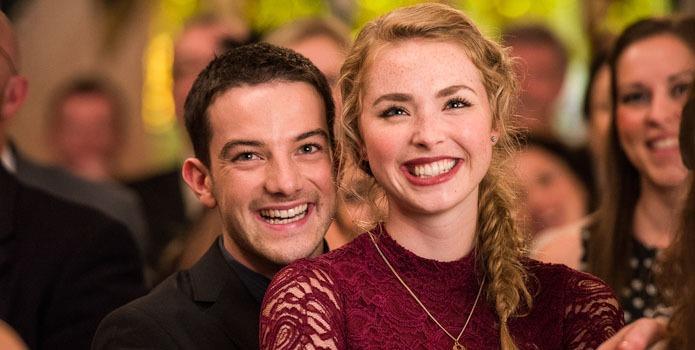
One of the reasons Sunshine on Leith works as a film at all is that it tries to create a sense of a shared city life rather than a vacuum around the leads. Musical numbers take place in pubs, streets, parks, workplaces—spaces that feel public, not theatrical. That only works if the background world feels convincing.
The film benefits from a supporting cast that understands the rhythms of Scottish social life: the way affection and insult sit side by side, the way emotions are often communicated through humour, the way celebrations can suddenly turn into reckonings. Even when minor characters have limited screen time, they add texture. You are meant to feel that these people belong to Edinburgh, rather than being dropped into it for the sake of a location shoot.
There is also, inevitably, a kind of local pride involved in casting. A story so rooted in a specific place carries a responsibility: not to present the city as a tourist fantasy, and not to flatten its class and cultural variety into clichés. Sunshine on Leith is not a documentary, but it is conscious of authenticity in accent, manner and setting. The actors carry a large part of that responsibility. If the voices don’t convince, the entire enterprise begins to wobble.
This is where the casting mix becomes important. Some of the principal actors are Scottish; others are not, but work to inhabit the speech patterns and social codes of the setting. In a musical, where performance is already heightened, a false note in accent or behaviour is especially easy to hear.
Singing The Proclaimers on film: acting through familiar lyrics
A key question for any adaptation built on famous songs is how to stop the music from feeling like a jukebox selection forced into narrative. Sunshine on Leith makes a conscious effort to integrate songs as expressions of character rather than interruptions. That is where the actors’ approach becomes the difference between “people singing in a film” and “characters compelled to sing”.
The Proclaimers’ songs present particular challenges. Many are written in a direct, conversational style. The lyrics can sound like speech. That means an actor can’t hide behind vocal technique; the line readings are exposed. If an emotion isn’t earned in the scene, the song will feel like decoration.
The cast generally adopts an unvarnished vocal style. Numbers are staged to feel communal or spontaneous rather than studio-perfect. That choice fits the source material, which has always been about ordinary life elevated by melody rather than by glamour. It also fits the Scottish setting, where public singing is often tied to collective occasions—football, weddings, nights out—rather than the polished world of stage performance.
This aesthetic is also strategic. If Sunshine on Leith had aimed for slick vocal perfection, it would have created a distance between the audience and the story, turning Edinburgh into a set and the characters into performers. By keeping voices relatively natural, the film signals that it wants to be treated as a drama that happens to sing, not a musical that occasionally remembers it needs plot.
That does not mean every musical moment works equally well. Some sequences inevitably feel more choreographed, more “set piece”, and different viewers will have different tolerances for that. But the cast’s collective commitment to sincerity—an unfashionable word in film criticism, perhaps, but the right one here—gives the songs a fighting chance.
Scottishness without tartan: accents, class and the film’s social world
Sunshine on Leith is often described as a Scottish feel-good musical, but that label can be misleading. The film’s Scottishness is not primarily a matter of scenery or symbolism. It is expressed through class textures, social habits and the way characters speak to each other.
The actors’ job is to convey that without reducing it to a performance of “Scottish character”. That means making working lives visible, not just romantic lives; making families feel shaped by history, not simply by current plot points. It means treating humour as a tool for survival and connection, not just as a comedic garnish.
This is another reason the older cast matters so much. Horrocks, Mullan and Flemyng allow the film to explore older forms of masculinity and femininity, older approaches to responsibility and concealment. The younger cast then plays the collision between those inherited patterns and contemporary expectations. The story’s tensions are not just personal; they are generational.
For viewers asking about actors in Sunshine on Leith, this social dimension may not be the first thing they have in mind, but it is central to why the casting is effective. The performances do not rely on the songs to do all the emotional work. They build a credible world in which those songs have a place.
What the cast tells us about British film musicals
British cinema has never had the same industrial relationship to musicals that Hollywood has. When a British musical succeeds, it often does so by leaning into specificity: a particular community, a particular voice, a particular sense of humour. Sunshine on Leith follows that pattern, and the casting reflects it.
Rather than importing performers known primarily for musical theatre, the film largely leans on actors with strong screen instincts. That is a telling choice. It suggests that the production understood the key risk: that the film might feel like theatre filmed outdoors. By prioritising screen credibility, it aims to make the musical element feel like an extension of character, not a replacement for it.
This is also why the ensemble is so important. Hollywood musicals can sometimes rely on the sheer spectacle of star power. Sunshine on Leith cannot. Its spectacle is Edinburgh itself and the collective familiarity of the songs. The cast must therefore provide the dramatic stakes, especially in the domestic plotlines where the film’s biggest emotional shifts occur.
Conclusion: why this particular ensemble remains the film’s strongest argument
Sunshine on Leith will always be judged partly through the lens of its soundtrack. People bring their own relationships to The Proclaimers’ music, and those relationships can be affectionate, sceptical, or fiercely personal. But the film’s lasting interest lies in how it uses performance to make those songs function as storytelling.
The actors in Sunshine on Leith do not simply “perform” numbers; they attempt to inhabit them. George MacKay and Paul Brannigan make the central friendship feel lived-in. Freya Mavor and Antonia Thomas give the romances contrasting energies rather than mirror-image plots. Kevin Guthrie stops the story narrowing into a tidy two-couple narrative. Jane Horrocks provides the emotional nerve, while Peter Mullan and Jason Flemyng supply the adult complications that give the film weight.
In the end, the casting is what allows Sunshine on Leith to aim for sincerity without collapsing under it. The film asks its audience to accept sudden singing as a truthful form of speech. That is an audacious request in British cinema. It is only plausible because the performances, taken together, insist on a recognisable human world beneath the melody.