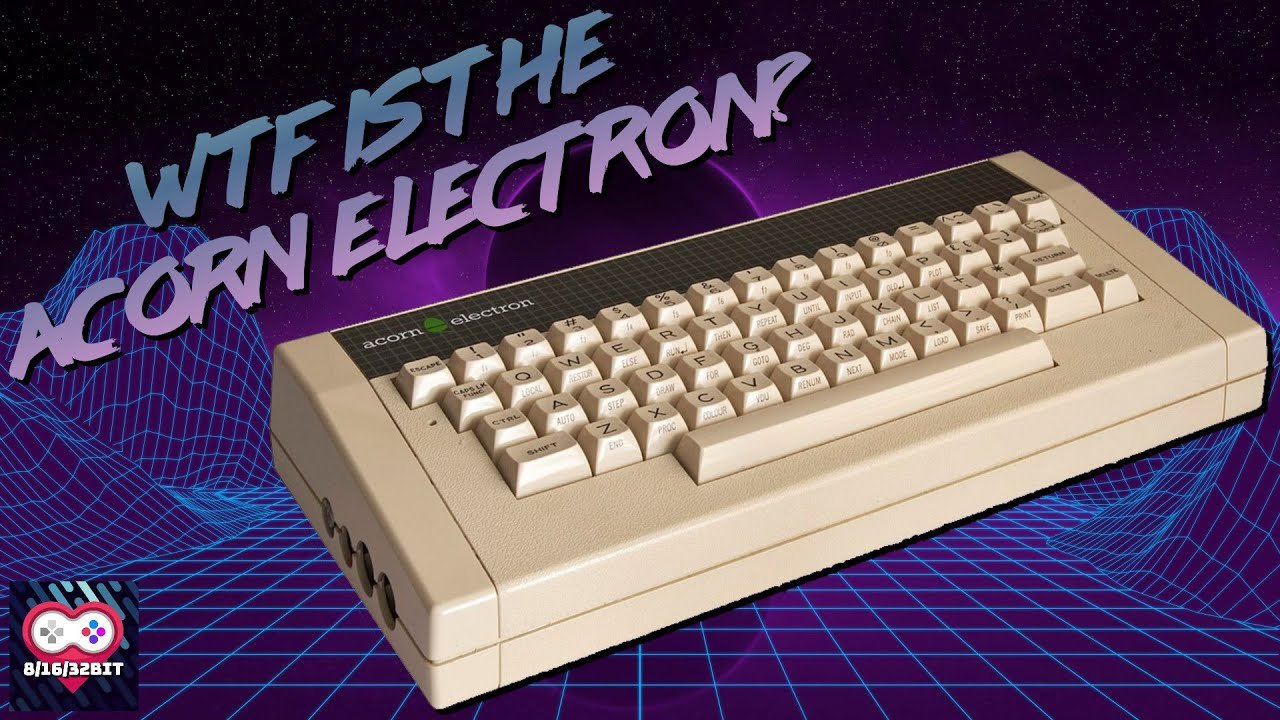
In the early 1980s, Britain did something unusual. It treated computing not merely as a business opportunity or a hobby for the technically minded, but as a national project. The BBC’s Computer Literacy Project put programming on prime-time television, schools filled classrooms with beige micros, and parents began to see a keyboard as a plausible Christmas present. Out of that brief, intense moment came machines that still stir strong feelings: the Sinclair Spectrum, the Commodore 64, the Amstrad CPC, and, sitting slightly apart from the rest, the Acorn Electron computer.
The Electron occupies a curious position in the UK’s computing memory. It was designed to bring the BBC Micro experience into the home at a lower price, yet it arrived into a market that had already turned fiercely competitive. It shares a family resemblance with Acorn’s more famous machine, but it is not simply a cut-down BBC; it is its own design, with its own quirks, strengths, and frustrations. For some, it was a first taste of coding in BBC BASIC. For others, it was the machine that looked brilliant on paper and felt oddly sluggish in use. And for Acorn itself, it was part of a turbulent commercial story that helped shape the company’s future.
To understand the Acorn Electron computer properly is to look at what it tried to be, why it mattered, and what its legacy tells us about British technology in an era when “home computing” still meant a television, a cassette recorder and a lot of patience.
The Britain that made room for a home micro
By 1983, the UK home computer market was already crowded and noisy. Sinclair had made low-cost computing mainstream, Commodore had pulled the price of a capable games machine down to domestic levels, and shops from WHSmith to specialist electrical retailers were stacking boxes with bright, optimistic artwork. At the same time, schools were buying computers in bulk, often with public money, and a generation of children was learning that typing a line of code could make something happen on screen.
Acorn’s BBC Micro, launched in 1981, benefited directly from that national mood. It was relatively expensive for a home machine, but it was powerful, expandable, and backed by the BBC’s educational credibility. Many families, however, could not justify the price. The gap between what schools were using and what most homes could afford created a clear commercial temptation: take the BBC Micro’s appeal and repackage it into something cheaper, smaller and simpler.
That temptation is where the Electron begins. It was never intended as a niche enthusiast’s device. The Acorn Electron computer was meant to be the people’s BBC: an Acorn machine for bedrooms and living rooms, not just for classrooms and clubs.
What the Electron was meant to be
Acorn’s pitch, in essence, was compatibility and credibility. The Electron would run similar software to the BBC Micro, speak the same BASIC, and feel familiar to children who were already meeting Acorn machines at school. The hope was that the Electron could turn educational exposure into household demand, creating a pipeline from classroom to home.
There is a certain logic to that strategy, and it was not unique. Other companies also tried to trade on education and “serious” computing. The difference for Acorn was that it already had a machine associated with the BBC, and therefore with authority. If you were a parent in 1983 weighing up a Spectrum against something that sounded like “the one they use at school”, the Electron had a clear rhetorical advantage.
Yet a lower price point demands compromises, and the Electron was built around a particular engineering decision: consolidate the machine’s functions into a custom chip, reducing component count and manufacturing cost. That decision helped make the Electron compact and relatively elegant inside. It also contributed to the performance limitations that would follow it around.
Inside the Acorn Electron computer: clever design, awkward consequences
At heart, the Electron is a 6502-based micro, like the BBC Micro. Its CPU is a MOS Technology 6502A running at 2MHz in principle, paired with 32KB of RAM and 32KB of ROM containing the operating system and BBC BASIC. Those numbers sound respectable for a mid-1980s home computer, and in many respects the Electron is capable.
The key difference is the way the machine shares access to memory and video. Acorn’s custom ULA (Uncommitted Logic Array) in the Electron handles much of what the BBC Micro spreads across multiple chips: video generation, memory timing, input/output and sound. Consolidation lowered cost and reduced board complexity. But because the ULA is responsible for producing the video signal, it must repeatedly take priority access to memory to fetch screen data.
The practical effect is that the CPU is frequently slowed down when the display is active, because it has to wait while the video circuitry does its work. Users experienced this as a machine that could feel noticeably slower than expected, particularly in graphics-heavy games and programs. It is one of the reasons the Electron’s reputation is oddly split: technically sophisticated in design, yet sometimes frustrating in everyday responsiveness.
There were workarounds and clever tricks. Some software would reduce the amount of on-screen change or use display modes that imposed less strain. Some programmers timed routines to moments when the CPU had more breathing space. But these are the sorts of strategies that only become visible when you already have a community of developers determined to get the most out of the machine. For ordinary users, the Electron could seem to lag behind rivals that cost the same or less.
This is not to say the Electron was underpowered in every sense. It could run a full version of BBC BASIC with a fast interpreter and a clear, structured feel that many British programmers still rate highly. For learning and experimentation, it could be a very capable companion. The trouble was that the market increasingly judged home machines by games performance, smooth scrolling and sound, and that is where the Electron had to work harder to impress.
Graphics and display: familiar modes, missing teletext
The Electron’s graphics are closely related to the BBC Micro’s display modes, which gave it a broad palette of resolutions and colour depths for the time. In practice, you could choose between higher resolution with fewer colours or lower resolution with more colours, depending on the mode and the memory available for screen data.
One notable omission from the base Electron was Mode 7, the BBC Micro’s teletext-style display mode that relied on a specific character generator chip. Mode 7 was a hallmark of BBC Micro computing in schools: colourful text, sharp characters, and a distinctive look. Its absence on the Electron mattered less for games than for educational software and the general sense of “this is the same machine”. It became one of those small differences that children noticed when they tried to run a school program at home and found the display did not match.
Third-party hardware and later expansions could add teletext capability, but out of the box the Electron made a simpler offer: broadly BBC-like graphics without the full BBC hardware set. Again, the Electron’s story is one of near-compatibility rather than perfect identity.
Sound: adequate for learning, limited for spectacle
Sound is another area where the Electron diverged from the BBC Micro. The BBC Micro’s sound capabilities, driven by a dedicated sound chip, allowed multiple channels and more varied effects. The Electron’s integrated design offered a more limited audio experience. It could produce basic tones and noise effects, and it supported the familiar SOUND command structure in BBC BASIC, but it did not deliver the same richness and flexibility as its bigger sibling.
In a classroom context, that limitation was rarely decisive. In a living room where children compared games with friends who owned a Commodore 64, it could be. The home market of the mid-1980s was increasingly driven by audiovisual impact. The Electron could display games and play them competently, but it often sounded and felt more restrained than the best of its contemporaries.
Expansion: the promise of “more later”
Acorn knew the Electron had to be expandable if it was to inherit some of the BBC Micro’s credibility. Part of Acorn’s appeal, particularly in schools, was that the machine could grow: disc drives, printers, networking, second processors, all of it bolted onto a capable core. The Electron’s base unit was deliberately minimal, with a focus on keeping the initial purchase price down. Expansion was where Acorn hoped to satisfy more demanding users.
This is where the “Plus” add-ons enter the story. The Plus 1 expansion unit, for example, added cartridge slots and additional ports, making the Electron more flexible for games and peripherals. Cartridges were an attempt to simplify loading and reduce the dependency on tape, which was slow and error-prone. A cartridge could turn the Electron into something closer to a console experience: switch on, load quickly, get on with it.
Other expansions aimed to bring disc storage and additional interfaces within reach. Disc systems were important for serious use, saving work reliably, and running larger applications. In the UK, the shift from cassette to disc was also a social marker: discs suggested commitment, not casual dabbling.
Yet expansion is only valuable if it is affordable and widely supported. The Electron’s add-ons were not always cheap, and the more you spent to turn an Electron into a fuller-featured system, the more you approached the price of machines that offered better performance or stronger games libraries in the first place. This was the Electron’s persistent dilemma: it was designed as a lower-cost alternative, but it sometimes required extra spending to meet the expectations that came with the Acorn name.
Software and BBC BASIC: the Electron at its best
For many owners, the Electron’s defining strength was not a particular game or peripheral but the experience of programming in BBC BASIC. Compared with some rival BASIC dialects, BBC BASIC was structured, fast, and practical. It encouraged good habits: named procedures and functions, readable code, and a sense that you were learning something transferable rather than merely tinkering.
This mattered enormously in the UK, because so much informal computer learning happened at home. Children copied listings from magazines, typed in short programs to draw shapes or play tunes, and gradually learned what variables and loops were by sheer repetition. The Electron made that process relatively approachable. It was not the only machine to do so, but it benefited from being part of an ecosystem where BBC BASIC was already seen as a “proper” language.
The software library for the Electron included educational titles, utilities, and, crucially, games. Many BBC Micro titles were ported or adapted, and some publishers supported the Electron directly. Still, the machine lived in the shadow of larger markets. The Spectrum and Commodore 64 attracted immense developer attention, which meant sheer volume and variety. The Electron could not always match that breadth, and when it did receive ports they could be uneven, depending on how well developers worked around its performance characteristics.
Tape loading, meanwhile, remained part of the experience for a large proportion of users. The ritual will be familiar to anyone of a certain age: rewind the cassette, adjust the volume, press play, watch the screen, hope the program loads without a “Data?” error. It was slow, but it was also a shared cultural practice. The Electron sat squarely in that era.
Schools, compatibility and the BBC Micro shadow
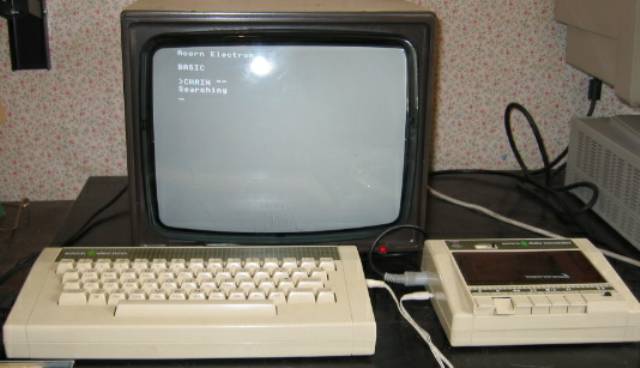
A common assumption is that the Electron was a “school computer” because it spoke BBC BASIC. In reality, schools overwhelmingly bought BBC Micros, not Electrons, and for good reasons: better expandability, more robust build, stronger I/O, and a clearer upgrade path. The Electron was aimed at homes.
However, the school connection mattered psychologically. For families, the idea that a child could practice BBC BASIC at home had real appeal. For children, using similar commands and seeing similar prompts created continuity. That continuity was not perfect, and those missing features—teletext display, sound capabilities, certain interfaces—could become obvious in use. But the broader alignment still offered something valuable: a machine that felt educational without being joyless.
In that sense, the Electron’s role is best understood as bridging two worlds. It sat between the mass-market gaming orientation of the Spectrum and the more formally educational identity of the BBC Micro. That was a clever positioning. It was also a difficult one to maintain as the market hardened around price, performance and entertainment value.
The business story: timing, delays and a brutal market
The Electron’s commercial fate was shaped as much by timing as by design. The early 1980s home computer market moved fast. A machine could be announced to great excitement and then find itself overtaken before it reached shops in volume.
The Electron suffered delays and supply challenges, and it launched into a market that was already shifting. Prices were falling. Competitors were aggressive. Consumers were becoming more savvy. The notion of paying a premium for “British educational credibility” was real, but it had limits when a Spectrum could be bought cheaply and loaded with games.
By the mid-1980s, the industry also felt the aftershocks of a global correction in the videogames market, and while the UK micro scene did not collapse in the same way as parts of the US console market, it did become more ruthless. Companies overproduced, retailers discounted heavily, and margins tightened. A machine designed to hit a certain price point could become exposed if it missed its moment.
Acorn itself went through turbulence in this period, and the Electron is part of that larger narrative. The company that would later give the world ARM architecture was, in the mid-1980s, still a British microcomputer manufacturer trying to survive in a volatile consumer electronics market. The Electron did not destroy Acorn, but it did not secure the mass home dominance that had been hoped for either.
The Electron’s afterlife: preservation, emulation and a quiet legacy
What is striking about the Acorn Electron computer today is how strongly it persists as a cultural object. It appears in retro computing collections, online forums, and emulation projects. Part of that persistence is nostalgia, but part of it is genuine interest in a design that was, in its own way, ingenious.
Modern emulation has allowed the Electron’s software library to be explored without the practical frustrations of tape loading and ageing hardware. Meanwhile, hardware enthusiasts continue to repair original machines, replace failing components, and build modern storage solutions that mimic disc systems or allow software to be loaded via SD cards. These efforts are not merely sentimental; they are a form of conservation of Britain’s computing heritage.
The Electron’s broader legacy also sits within Acorn’s story. The company’s later pivot toward more advanced systems and eventually toward ARM-based designs is often told as a separate chapter, but the through-line is a commitment to efficient engineering and integrated design. The Electron’s ULA-centric approach, with all its trade-offs, is part of that mindset.
In other words, even where the Electron fell short commercially, it still reflects a distinctive British approach to making computers: pragmatic, cost-aware, technically ambitious, and shaped by a belief that computing could be part of everyday life.
Conclusion
The Acorn Electron computer was born from a straightforward ambition: bring the BBC Micro experience into the home at a price ordinary families could contemplate. It delivered a great deal of what was promised, especially for those who wanted to learn BBC BASIC and explore programming in a serious but accessible environment. It also carried the compromises of its design into the most competitive arena of all: the mid-1980s home market, where games performance, sound, and perceived value often mattered more than elegance of engineering.
Its reputation remains mixed because it truly was a machine of mixed character: clever and constrained, educationally strong yet sometimes audiovisually underwhelming, closely related to the BBC Micro but not identical to it. That complexity is why it still attracts interest. The Electron is not simply a footnote. It is a reminder of how Britain tried to put computing into the hands of the public, and of how hard it is to build a “budget version” of a beloved machine without inheriting expectations as well as heritage.