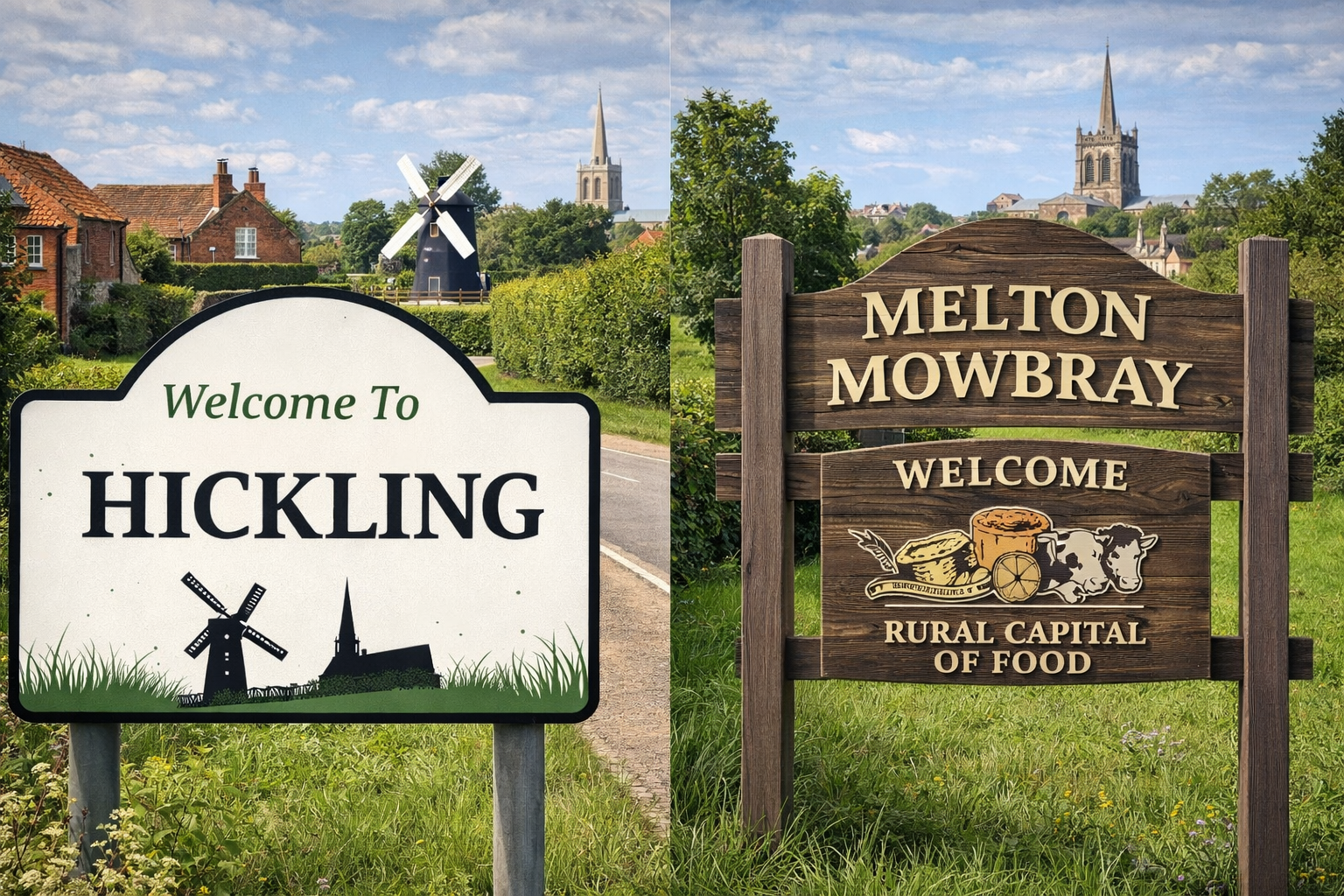
For many people in the East Midlands, the name Melton Mowbray immediately conjures a proper market town: livestock history, food traditions, and a centre that still draws in surrounding villages for shopping, schools and services. Hickling, by contrast, is quieter and easier to miss on a first pass. Yet the relationship between the two matters. If you are trying to understand hickling melton mowbray as a place-name pairing, you are really asking how a small rural village fits into the orbit of a larger town, and what that means on the ground for travel, housing, community life and access to the basics.
Hickling sits in a landscape shaped by fields, lanes and watercourses, close to county lines and the practical geography of everyday errands. It is rural without being remote. It is not a museum village, and it is not a commuter suburb either. Like many settlements around the Nottinghamshire–Leicestershire border, it is best understood through its connections: the roads that lead to Melton, to Bingham and Nottingham, and to Grantham; the patchwork of farms and small businesses; the pull of nearby towns for work, GP appointments and supermarkets; and the strong local instinct to organise village life around what is available.
This article sets out what Hickling is, how it relates to Melton Mowbray, and what prospective residents, visitors or the simply curious should know before assuming it is “just another village”.
Where Hickling sits in relation to Melton Mowbray
Hickling is a Nottinghamshire village in the wider Vale of Belvoir area, close to the Leicestershire border and within straightforward driving distance of Melton Mowbray. That proximity explains why people often search for hickling melton mowbray together: Melton is the town many locals use as a reference point, whether they are booking a train, choosing a secondary school, or planning the weekly shop.
The most direct route between Hickling and Melton is typically by road, using the A606 corridor and connecting lanes depending on where you are starting and ending. In time terms, the journey can be quick in clear conditions and slower when tractors are out, when there is standing water after heavy rain, or when roadworks bite on key junctions. These are not dramatic distances, but they are rural distances: the kind where ten miles does not always behave like ten miles in a city.
It is also worth appreciating the “direction of travel” in daily life. Some households lean towards Melton for shopping and services; others look to Bingham, Keyworth or Nottingham depending on work patterns and family ties. Hickling’s location makes it a genuine borderland settlement: not in the sense of cultural detachment, but in the sense that administrative boundaries do not always match real routines.
Landscape, farming and the feel of the countryside
The countryside around Hickling is not wild or mountainous; it is working land. Fields, hedgerows, ditches and quiet lanes define the view. This matters because it shapes everything from weekend walks to flood risk, from the type of wildlife you see to how bright the night sky feels.
In this part of the East Midlands, agriculture remains a central presence. You notice it in the timing of heavy vehicles on narrow roads, in the smells that drift with a change of wind, and in the seasonal shifts: bare fields and hard frosts, then a fast green-up in spring, then the long stretch of summer growth and harvest. Anyone considering a move should be honest with themselves about the practicalities. Rural living can be deeply peaceful, but it comes with noise at the wrong hour, mud on lanes, and a rhythm dictated by weather and crops rather than timetables.
Water is another quiet influence. The area’s drainage network, small streams and low-lying land can become a real issue in prolonged wet periods, affecting footpaths, verges and the ease of driving. The presence of the Grantham Canal nearby, much of it restored in sections over recent decades, adds both character and complexity: it is a piece of industrial heritage that now functions as a wildlife corridor, a walking route and a local landmark.
The canal connection and what it tells you about the area
One of the most distinctive features near Hickling is the Grantham Canal, with stretches that have been the focus of long-running restoration and conservation efforts. You do not have to be a canal enthusiast to see why it matters. It is a reminder that this landscape has long been shaped by transport and trade, not just by farming. Where the canal is accessible, it offers level walking, a sense of shelter from open fields, and a different view of the countryside at hedge height.
The canal also points to a broader truth about hickling melton mowbray: this is a region built on connective tissue. In the 18th and 19th centuries, waterways and later railways helped goods move between market towns and cities. Today, A-roads and regional rail lines do the heavy lifting. The old routes still influence where people choose to live, and how communities relate to one another.
A brief sense of local history, without the romantic gloss
Hickling’s history is not the kind that announces itself in grand monuments, but it is present in the shape of the village, the age of some buildings, and the way the settlement sits on its lanes. Like many villages in this part of Nottinghamshire, it grew as an agricultural community, tied to landownership patterns, parish structures and the long evolution of rural labour.
The parish church, as in many English villages, is part of the story: a marker of continuity as well as a practical building used for services, events and remembrance. Even if you are not religious, churches in villages like Hickling often function as historical archives in stone, carrying memorials, local surnames and evidence of changing tastes in architecture and restoration.
What is striking, if you look closely, is the way the 20th century sits alongside older layers. Rural villages that look “traditional” from a distance often contain post-war housing, small-scale infill development and practical modern alterations. They are lived-in places, not heritage sets. That mixture tends to be a better guide to Hickling than any single narrative about “the old days”.
Daily life: amenities, expectations and what you need to plan for
The most important thing to understand about Hickling is what it does not have. A village of its scale will not offer the range of shops, services and leisure facilities you would expect in Melton Mowbray. That does not mean village life is deprived; it means it is structured differently.
Basic errands typically involve driving to a nearby town or larger village. For many households, that means planning ahead: combining trips, keeping an eye on fuel costs, and knowing that a late-night run for essentials is not always convenient. Deliveries can fill some gaps, but rural delivery slots and mobile coverage can affect how easy that is in practice.
At the same time, small places often have a strong infrastructure of informal support. Village halls, local committees, church groups, community events and the habit of looking out for neighbours can matter more than they do in a town. The trade-off is familiar across rural England: fewer amenities within walking distance, but a stronger expectation that people will contribute to the social fabric if they want it to thrive.
For anyone weighing up hickling melton mowbray as a potential move, the sensible question is not “is it quiet?” but “how do I live here on a Tuesday in February?” That is when the realities of distance, darkness, bus timetables and childcare become clear.
Transport and commuting: what is realistic, and what is optimistic
Hickling is fundamentally a car-oriented place. Public transport exists in the wider area but can be limited in frequency and timing, particularly outside peak commuting hours and at weekends. That may not be a problem for every household, but it should be confronted early, especially for younger people, older residents who may stop driving, or anyone planning a commute that relies on tight connections.
For rail travel, residents often use nearby stations depending on direction and service patterns. Bingham and Bottesford are commonly considered for routes towards Nottingham and Grantham, while Melton Mowbray station serves its own lines and connections further afield. In practice, that means many journeys begin with a drive and a choice: which station gives the best balance of parking, service frequency and overall time.
Road access is comparatively straightforward, particularly via the A606, which acts as a key spine linking settlements across this part of the region. Yet “straightforward” does not mean stress-free. Rural A-roads can be fast, and junctions can feel exposed. Winter weather can turn minor roads into an exercise in caution. Anyone used to urban driving should expect a different set of risks and rhythms.
Schools, healthcare and the pull of the market town

Schooling is one of the strongest practical links between Hickling and surrounding towns. Primary provision may be in the village or nearby (arrangements vary and can change), while secondary education and sixth-form options often mean travel to larger centres. Melton Mowbray’s role as an educational and service hub is part of why the pairing hickling melton mowbray appears so often: families naturally measure the village by how it connects to the town’s schools, sports facilities and clubs.
Healthcare follows a similar pattern. A village may have a nearby GP practice serving a wider area, but many appointments, clinics and hospital visits will involve travel. Melton provides some services; Leicester and Nottingham are important for larger hospitals and specialist care. These are manageable distances for many, but they require planning, particularly when appointments are early, when weather is poor, or when you are juggling work.
It is also worth acknowledging that access is not only about distance. It is about appointment availability, transport options for those who cannot drive, and the administrative boundaries that shape referrals and catchments. Rural convenience is often less about miles and more about whether the system is designed for people who live beyond the ring road.
Housing stock, costs and the texture of the village
Housing in and around Hickling tends to be a mix, often including older cottages, farmhouses and later additions from different decades. The character of the housing stock can be appealing to some and frustrating to others. Older properties may come with quirks: insulation challenges, narrow staircases, limited parking, or the need for careful maintenance. Newer homes may offer easier running costs but sit within tighter estate layouts.
Prices fluctuate with the wider regional market, and the village’s appeal is tied to its rural setting and its access to nearby towns. It would be misleading to suggest Hickling is uniformly expensive or uniformly affordable; much depends on property type, condition, plot size and how the local market is behaving at any given time.
Anyone considering buying should also think beyond the front door. In rural settings, practical questions matter: drainage, broadband speed, mobile signal reliability, flood history, rights of way, and how close you are to busy routes or working farms. These factors do not always show up in estate agent descriptions, but they shape daily life far more than a pretty view does.
Work and the local economy: not just commuting, not just farming
It is easy to assume that villagers either farm or commute. The reality is more mixed. Some residents do travel to Melton, Nottingham, Leicester or Grantham for work, using the road network as their lifeline. Others work locally in trades, small businesses, logistics, care, education or remote roles that have become more common since the pandemic.
Melton Mowbray’s economy plays a role here, with its combination of food production heritage, retail and services, and employment linked to the wider Leicestershire economy. But Hickling’s economic life is not simply dependent on Melton. The village’s position between several centres means work patterns can point in multiple directions, and that diversity can provide resilience when one sector or town is under strain.
Remote working has altered the calculation for some households, but it brings its own caveat: the quality of broadband and mobile coverage is not an abstract concern in rural areas. Before committing to a move framed around home working, it is sensible to check real-world connection speeds, not just advertised coverage.
Walks, wildlife and how people actually use the landscape
One of the strongest draws of this area is the ability to step out into open countryside quickly. Footpaths, bridleways and canal-side stretches offer routes that change with the seasons. The pleasure here is not in dramatic vistas but in the details: the sound of wind in hedges, the sudden movement of birds over fields, the way frost sits in low ground.
That access, however, is governed by the practical etiquette of rural England. Paths can be muddy and uneven. Dogs may need leads near livestock. Gates should be treated properly, and crops respected. For newcomers, the learning curve is usually quick, but it is worth stating plainly: the countryside around Hickling is working countryside, and recreation sits alongside production.
Melton Mowbray, meanwhile, provides the complementary offer: parks, leisure centres, organised sport, and a town centre where you can combine a walk with a café, a shop and a busier sense of place. In that way, hickling melton mowbray functions as a two-part lifestyle for many residents: quiet at home, activity and services in town.
Planning, development and the question of change
No village is static. Hickling, like many settlements within reach of larger towns and cities, sits within wider debates about housing need, infrastructure strain and the preservation of character. Development may arrive as small infill, conversions, or larger proposals in nearby areas that nonetheless affect traffic, school places and local services.
Conservation and heritage considerations can play a role, particularly where older buildings and historic streetscapes are involved. But planning is not solely about aesthetics. It is about whether roads can handle more cars, whether drainage is adequate, and whether the village can absorb growth without losing the social glue that makes it function.
For residents, the tension can be real. Some will argue for protecting a rural settlement from being swallowed by incremental development; others will point to the need for homes that younger families can afford and for the benefits of keeping a village viable. Understanding Hickling means recognising that both arguments are often made by people who care about the place, even when they disagree.
Hickling and Melton Mowbray together: what the pairing really tells you
When people search hickling melton mowbray, they are often trying to locate themselves in relation to a known quantity. Melton is the reference point: a place with shops, schools, a station, and the familiar busyness of a market town. Hickling is the quieter counterpart: a village setting that relies on those nearby services while offering a different pace and landscape.
The key is not to oversell either side of that equation. Hickling is not an isolated idyll, and Melton is not a distant metropolis. They are part of a shared local geography where rural and town life interlock. If you are visiting, that means you can combine a countryside walk with a practical town stop. If you are considering a move, it means you need to be honest about travel, costs and daily routines, and clear about what you want the village to provide and what you are willing to travel for.
Hickling’s value, in the plainest sense, lies in its steadiness: the continuity of a rural settlement that still functions as a community, set close enough to Melton Mowbray to remain connected but far enough away to feel distinct. That balance is delicate, and it is what makes the place worth understanding rather than assuming.