Ask a roomful of Londoners what county Enfield is in and you will often get more than one reply. Some will say Greater London without hesitation. Others will insist it is Middlesex. A few, especially those who know the area by train lines and shopping routes rather than maps, might even wonder whether it counts as Hertfordshire, given how quickly the suburbs give way to green belt and market towns beyond the M25.
The question “what county is enfield in” sounds straightforward, but it sits on top of a long history of boundary changes, administrative reform and the messy overlap between official geography and local identity. Enfield is a place where those layers are easy to see. Street by street, you can feel it shifting from inner suburban London towards the edge of the capital. In older references, it appears as part of a historic county that no longer exists as an administrative unit. In modern governance, it is unambiguously a London borough.
To answer properly, it helps to separate the legal position from the cultural memory, and to understand what “county” can mean in England today.
The short, official answer: Enfield is in Greater London
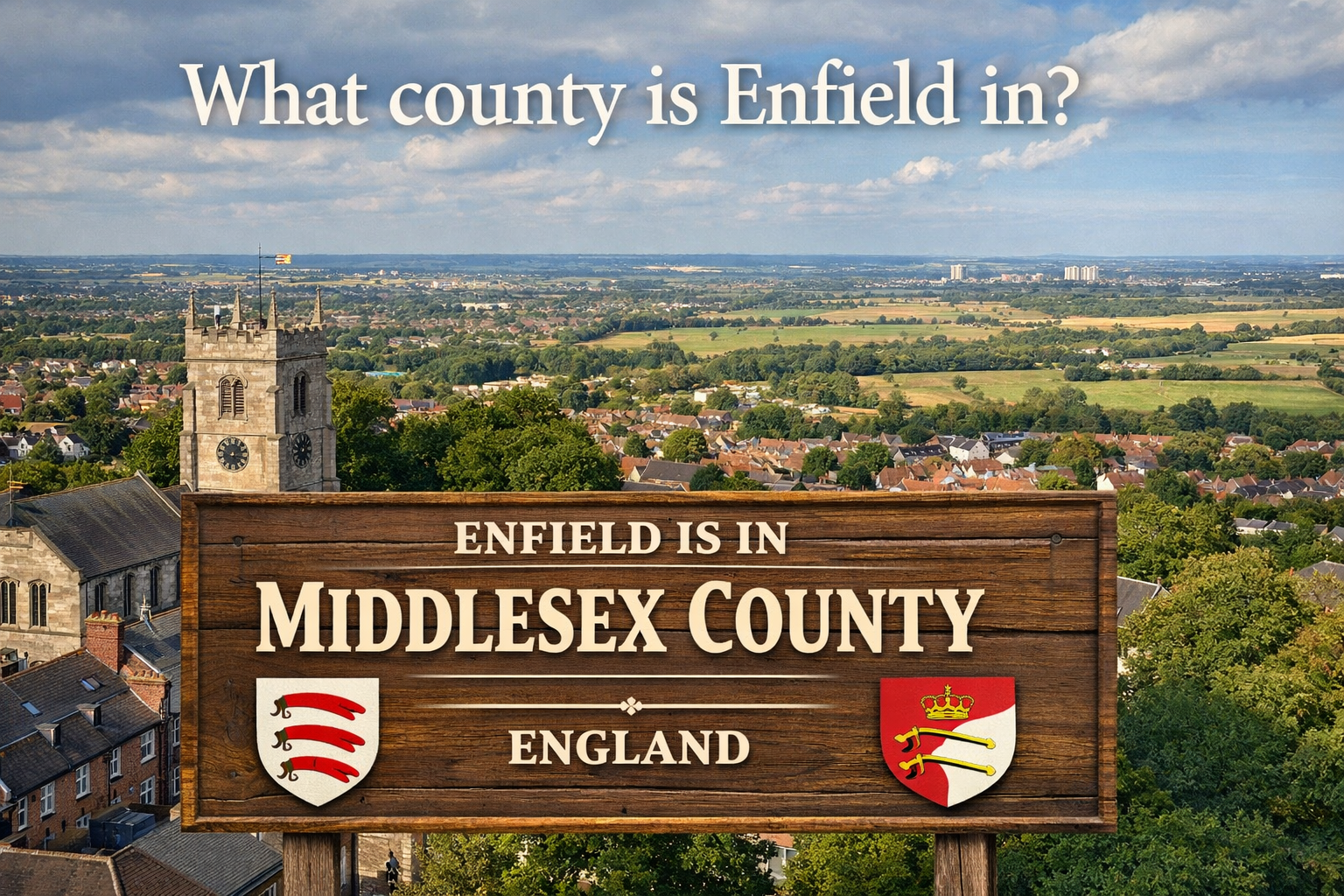
If you are looking for the most accurate contemporary answer to what county is enfield in, the answer is Greater London.
Enfield is a London borough, formally the London Borough of Enfield, and it sits in the north of Greater London. It is governed locally by Enfield Council and forms part of the Greater London Authority area, meaning that London-wide services and powers, such as those overseen by the Mayor of London and the London Assembly, apply.
In most modern, official contexts, Greater London is treated as the relevant county-level area. It is the ceremonial county for Enfield, which matters for certain formal roles and institutions, such as the Lord-Lieutenant’s area. It is also the administrative reality in terms of local government: Enfield is not under a county council in the way that many places outside London are. Like other London boroughs, it is a unitary-style authority within the wider London system.
So, if you are filling in a form, writing an address in a way that matches modern mapping databases, or simply trying to be accurate in 2026, “Enfield, Greater London” is the correct way to put it.
Why “Middlesex” still clings to Enfield’s name
The reason the question “what county is enfield in” refuses to die is that Enfield was historically part of Middlesex. For centuries, Middlesex was the county that covered a broad swathe of what is now north and west London, and Enfield sat within its boundaries.
Middlesex has not disappeared from the public imagination because it remains embedded in everyday life. You still see it in the names of institutions, in older documents, and in family memory. It appears on war memorials, in parish histories, and in the sporting landscape: Middlesex County Cricket Club plays at Lord’s, and the name carries a weight of tradition that does not vanish just because governance has changed.
For some residents, Middlesex feels like a truer description than Greater London. That is partly because Greater London is a relatively recent creation, and partly because “London” can feel like it describes the centre more than the edge. In Enfield, where streets can look and feel distinctly suburban, “Middlesex” can sound like a better fit to the character of the area, even if it is not the legal answer.
In short, Middlesex persists because history persists. But it is important to recognise what it is now: a historic county, not a current administrative one for Enfield.
The turning point: how Enfield became part of Greater London
To understand why Enfield is officially in Greater London, you have to go back to the reorganisation of London government in the 1960s.
Before 1965, the governance of the capital and its surrounding suburbs was fragmented. Inner London was covered by the old London County Council, but the expanding suburbs sat in neighbouring counties such as Middlesex, Essex, Kent, Surrey and Hertfordshire. As London grew, that arrangement became increasingly impractical. Housing, transport and planning did not stop at county lines, and the map no longer matched the lived reality of a capital region.
The London Government Act 1963 created Greater London, which came into being in 1965. This reorganised the borough structure and brought large areas of what had been Middlesex and parts of other counties into a single metropolitan framework.
Enfield, previously in Middlesex, became part of this new Greater London area. The modern London Borough of Enfield was formed by merging the former municipal boroughs of Enfield, Edmonton and Southgate. From that point onwards, Enfield’s administrative county association shifted decisively from Middlesex to Greater London.
This is the key moment behind the modern answer to what county is enfield in. The change was not a gradual drift in how people thought about the place; it was a legal restructuring that redrew responsibilities and boundaries.
What “county” means in England, and why the term causes confusion
When people ask what county is enfield in, they are often assuming that “county” is a single, clear category. In modern England, it is not. Several different types of county can exist at the same time, and they do different jobs.
Historic counties are the traditional counties that shaped identity, local allegiance and older administration. Middlesex falls into this category, as do counties such as Yorkshire in its historic form. Historic counties matter culturally, and they appear in older records, but they do not necessarily align with modern governance.
Ceremonial counties are used for certain official purposes, particularly relating to the Crown’s representatives and some formal institutions. In this sense, Enfield is in the ceremonial county of Greater London.
Administrative counties relate to local government structures. Outside London, that might mean a county council area. Inside London, boroughs operate within Greater London, and the old county council model doesn’t apply in the same way. Enfield’s relevant administrative reality is that it is a London borough within Greater London.
Postal counties once existed as a sorting convenience for the Royal Mail. They were never quite the same as historic or administrative counties, and in practice their importance has declined further with the dominance of postcodes. It is still possible to see county names in some address traditions, but postcodes do the real work now.
The result is that different people can give different answers depending on which “county” they mean, and whether they are thinking historically, ceremonially, administratively, or simply in terms of what they grew up writing on envelopes.
What official systems and documents tend to use for Enfield
One practical way to settle “what county is enfield in” is to look at how the state and its systems treat the area.
Local government is the clearest. Enfield Council is the local authority, and it sits within Greater London. There is no Middlesex County Council to speak of; it ceased to exist as a governing body with the 1965 changes.
Policing is provided by the Metropolitan Police Service, another strong sign that Enfield is institutionally part of London.
Fire and rescue is covered by the London Fire Brigade.
Transport planning and major road strategy sit within the London framework, including bodies and decisions influenced by London-wide governance, even if some routes cross into neighbouring counties.
In property and planning, Enfield’s local planning authority is the borough council, operating under the planning framework that applies across London, alongside national planning policy.
Even when forms ask for “county”, many databases treat “Greater London” as the correct county-level entry for Enfield. Some older systems, and some individuals, still enter “Middlesex”, but this tends to reflect habit rather than modern administrative fact.
So, if you need the answer to what county is enfield in for something official, Greater London is the safest and most accurate response.
Enfield’s geography: a London borough on England’s county edges
Part of the reason confusion persists is that Enfield looks and feels like a border place. It is one of London’s northernmost boroughs, and it meets Hertfordshire directly. Drive north from Enfield Town and you can quickly find yourself near Potters Bar, Broxbourne and other Hertfordshire localities. The landscape shifts too, from suburban streets to stretches of parkland and green belt.
To the east, the River Lea and its valley form a significant natural and infrastructural corridor. This area has long been associated with industry, reservoirs and transport routes, and it links London to Essex and Hertfordshire in ways that do not always match tidy administrative narratives.
Enfield contains multiple centres and neighbourhoods with distinct characters, including Enfield Town, Edmonton, Southgate, Ponders End and others. Some areas feel strongly “London” in their density and transit links; others feel more like outer-suburban England. It is not surprising that people ask what county is enfield in when the lived experience can feel like being both in London and at the edge of it.
This border quality is not unique to Enfield, but it is particularly pronounced here because of the historic county boundary with Hertfordshire and the old affiliation with Middlesex.
Identity and belonging: why the answer matters to people
County questions are rarely just about geography. They are about belonging, accent, family history and the mental map people carry.
For some, saying Enfield is in Greater London means accepting that Enfield is London, full stop. That can be a point of pride, especially given London’s global profile and the practical advantages of being within its transport and cultural orbit.
For others, Greater London sounds bureaucratic, while Middlesex sounds like home. Middlesex can conjure a particular suburban history: interwar housing, local high streets, football on Saturdays, and the sense of being near London without being swallowed by it. In that emotional register, “Middlesex” is a statement about character rather than administration.
There is also the social reality that London is often spoken about as if it has a single identity, when in fact it is a patchwork of places with different histories. Enfield’s history includes market town roots, large-scale suburban growth, post-war change and significant migration. The borough’s identity has been shaped as much by these processes as by any line on a map.
So when someone asks what county is enfield in, they may be asking for the legal answer, or they may be asking for a shorthand that captures how the place feels. Those are not always the same.
Practical implications: services, schools and the London systems
Although “county” can sound like a matter of heritage, it also has practical consequences. The fact that Enfield is in Greater London affects public services in ways that residents notice.
Schools are overseen by the local authority in its London borough role. Admissions, school place planning and education policy are shaped by the borough’s responsibilities and by London-wide pressures, such as housing churn and population change.
Health services are organised through NHS structures that reflect London geography. Hospital access and specialist services often run along London networks, while some patients will also find themselves using facilities near the Hertfordshire boundary depending on GP referral patterns and availability.
Elections and representation reflect London’s structure too. Enfield residents vote in London mayoral and assembly elections as well as in borough and parliamentary elections.
Planning and housing policy sits within a London context where land values, development pressure and infrastructure needs are often different from those in adjacent counties. Even when Enfield faces issues common to many English towns, it does so within a capital city framework.
This is where the official answer to what county is enfield in becomes more than a matter of pedantry. It helps explain why certain services are organised the way they are, and why Enfield’s political and economic pressures often resemble those of other London boroughs more than those of Hertfordshire towns nearby.
How to describe Enfield accurately, depending on context
If you want a description that will be understood by most people in the UK, “Enfield in north London” is usually the clearest. If the question is explicitly about counties, then “Enfield is in Greater London” is the correct modern response.
If the context is historical, genealogical, or about older records, it can be entirely appropriate to say that Enfield was historically in Middlesex. Many archives, family history sources and older maps will use that language, and you will find references to “Enfield, Middlesex” in documents created before 1965.
It is also worth being precise about neighbouring areas. Enfield borders Hertfordshire, but it is not in Hertfordshire. People sometimes mix this up because towns just beyond the boundary can be closer to parts of Enfield than central London is, but the administrative line is clear.
In other words, the best answer to what county is enfield in depends on whether you mean “now” or “historically”. Most of the time, people mean now.
Conclusion: one place, two county stories
So, what county is enfield in? In modern terms, Enfield is in Greater London. That is the official and practical reality: it is a London borough with London governance, London services and London-wide political structures.
At the same time, Enfield’s historic county is Middlesex, and that older affiliation continues to appear in cultural references and personal identity. The persistence of Middlesex does not make the Greater London answer wrong; it shows how slowly place identity changes, and how much meaning people attach to the labels that framed their early lives.
Enfield sits at a boundary where these layers remain visible. The river corridors, the green belt edge, the quick transition into Hertfordshire, and the borough’s own mix of town centres and suburbs all contribute to a sense that the place is both London and something older. Understanding that is more useful than winning an argument about a single word on an envelope.