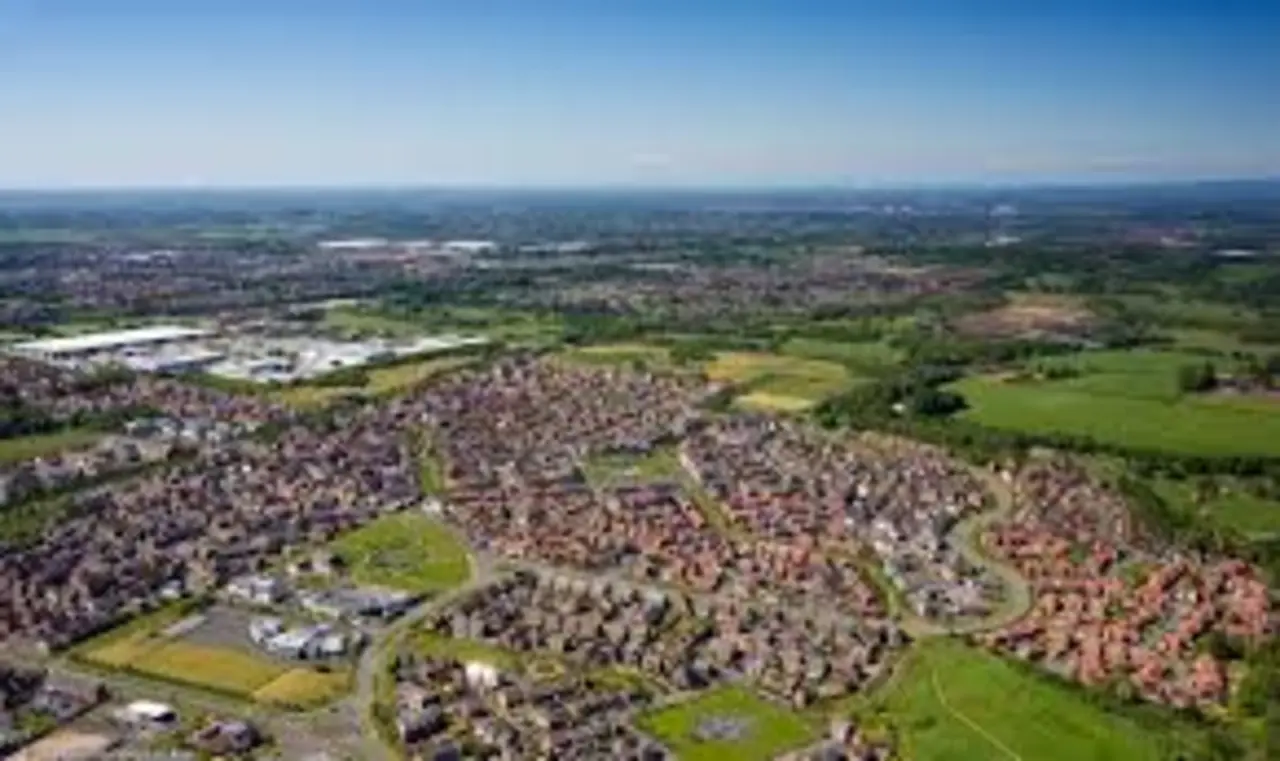
On the south-eastern edge of Chorley, where the flatlands begin to tilt towards the West Pennine Moors, Buckshaw Village sits with the self-contained air of a place that has arrived fully formed. Its streets are orderly. The houses are mostly modern, with consistent rooflines and tidy frontages. Footpaths cut between estates and green strips, and the everyday rhythm is that of a commuter settlement: early trains, school runs, supermarket car parks filling and emptying, lights coming on in the evenings across rows of recent-build homes.
Yet chorley buckshaw village is not simply “a new housing estate”, nor is it a traditional Lancashire village that has expanded. It is a planned community built on a site with a complicated industrial past and a present shaped by transport links, housing demand and the politics of development. For many people in the North West, it has become shorthand for a certain kind of 21st-century living: close to motorways and rail, within reach of Preston and Manchester, and designed around modern expectations of space, safety and convenience.
Understanding Buckshaw Village properly means looking beyond first impressions. It requires a sense of what was there before, why it was redeveloped, how it functions day to day, and what pressures it faces as Chorley and its neighbours continue to change.
Where Buckshaw Village sits, and why the location matters
Buckshaw Village lies between Chorley and Leyland, close to Euxton, with Preston a short drive or train journey away. The geography is important because this part of Lancashire has long been defined by movement: the M6 and M61 are nearby, the West Coast Main Line is close enough to shape commuter patterns, and a web of A-roads connects old mill towns, industrial estates and new housing.
In practical terms, chorley buckshaw village operates as a hinge point. Chorley’s town centre provides civic identity and older retail infrastructure, Leyland offers employment and its own services, while Preston acts as the regional hub with its university, hospitals and larger cultural institutions. The village’s popularity is closely linked to being within reasonable reach of all three.
The setting also explains Buckshaw’s particular feel. Unlike settlements that grew around a parish church or a market square, Buckshaw is oriented around access routes, neighbourhood pockets and amenities designed into the masterplan. It is the product of late-20th and early-21st century planning assumptions: that people will travel for work, that retail will be partly car-based, that green space will be designed in, and that a “village” can be built without the centuries of organic development that normally create one.
From Royal Ordnance to redevelopment: the land beneath the lawns
The most consequential fact about Buckshaw Village is that it was not always Buckshaw Village. The land was once part of the vast Royal Ordnance Factory site associated with wartime production. During the Second World War, ordnance factories across the country were crucial to the war effort, and the Lancashire sites formed part of a wider network of manufacturing and storage. The legacy of that era lingered long after the war ended, not only in local memory but in the practical challenges of repurposing such land.
As defence needs changed and old industrial sites were rationalised or closed, large tracts became available for redevelopment. But “available” did not mean straightforward. Land with an industrial or military history can demand extensive surveying, remediation and careful planning. Residents who arrive decades later may see only playing fields and new roads; what made the transformation possible was a long chain of decisions about clean-up standards, infrastructure investment and the kind of community that would be created.
The story of Buckshaw’s development is therefore partly a story about how Britain has handled post-industrial land. When housing shortages meet redundant industrial acreage, the pressure to build is intense. The question becomes what to build, how to connect it, and how to avoid repeating mistakes that created dormitory estates without services.
Buckshaw Village is frequently cited in local discussions as an example of a large-scale masterplanned development rather than a piecemeal sprawl. That has brought benefits, including coherent infrastructure and a sense of internal logic. It has also brought debate: masterplans can feel controlled, sometimes even anonymous, and they can struggle to create the accidental charm that older places accumulate over time.
What “village” means here: identity, boundaries and expectations
The term “village” can mislead. In a traditional sense, a village implies a small settlement, often with a historic centre, and a social fabric shaped over generations. Buckshaw Village is a village in the branding-and-planning sense: a defined area with housing, schools, shops and green space, intended to be walkable in parts and to feel separate from neighbouring towns.
For newcomers, that can be attractive. A clear boundary can make a place feel safer and easier to navigate. For critics, the same boundary can feel like a bubble, with less of the messy diversity that comes from older urban centres.
Identity in Buckshaw is also complicated by proximity. Many residents will say they live in Buckshaw Village rather than Chorley or Euxton, but their workplaces, GP surgeries, leisure routines and social lives may be spread across the area. The place functions as a home base in a networked region. That pattern is increasingly common across Britain, and it shapes local politics: people care deeply about roads, parking, schools and planning, because daily life depends on them.
In chorley buckshaw village, the “village” identity is strongest in the day-to-day: the school gates, the parks, the walking routes, the sense of being surrounded by people at a similar life stage. Whether that matures into a deeper civic identity over time depends on who stays long-term, how amenities evolve, and whether community institutions keep pace.
Housing: what’s been built, and who it tends to attract
Housing is the engine of Buckshaw Village. The dominant stock is modern: detached and semi-detached family homes, townhouses, and flats in smaller blocks. Streets are typically planned around loops and crescents rather than long terraces. Gardens are generally smaller than those found in older suburbs, but larger than in many city developments, and off-street parking is common.
These features align with a particular demographic pull. Buckshaw tends to attract young families looking for schools and parks, professionals commuting to Preston, Manchester or further afield, and people downsizing from larger properties who still want a modern, manageable home with decent connections. As with many new-build-heavy areas, there is also a mix of tenures: owner-occupied housing alongside private renting and some affordable provision, though the balance and visibility can vary by street.
The design of newer estates can shape social life. When houses are built with open-plan ground floors, integrated garages and fenced rear gardens, neighbours can live close while remaining private. Community forms, but it can require deliberate effort: school events, walking groups, local forums, and the small interactions that happen when people share dog-walking routes or wait at the same crossings.
One of the recurring questions for any large development is whether services and social infrastructure keep up with housing numbers. Buckshaw has benefited from having amenities built into the plan, but like many growing places it still faces the underlying tension: each additional phase of housing puts pressure on roads, schools, GP capacity and leisure space. Managing that pressure is a continuous task, not a one-off planning decision.
Transport and connectivity: rail, roads and the commuter reality
Buckshaw Village’s transport links are central to its appeal and its problems. The nearby motorway network makes it practical for residents to reach Preston, Bolton, Manchester and parts of Merseyside by car. The same network also brings traffic, especially at peak times and around key junctions. Like much of Lancashire, the region’s roads can shift quickly from free-flowing to congested depending on incidents and weather, and commuter settlements feel that volatility acutely.
Rail is a major factor. Buckshaw Parkway station, opened to serve the growing community, has changed patterns of movement and made the village more viable for people who prefer not to drive into city centres. The presence of a station within a modern development is not a small thing in Britain; many new housing areas are built without such direct access, leaving residents dependent on cars and worsening congestion. Here, rail offers a partial alternative, though its usefulness depends on service frequency, ticket costs and onward connections.
Bus services in the area provide additional links, but as in many parts of the country outside major cities, buses can be subject to route changes and pressures on funding. For residents without cars, or for teenagers and older people, the practical availability of public transport shapes independence and access to work and education.
Walking and cycling within Buckshaw is generally easier than in older towns built around narrow streets, because pathways and green corridors were part of the design. The challenge comes when journeys cross the village boundary. A route that feels safe and pleasant inside the development can become less comfortable when it meets faster roads or junctions built around car flow. For planners and local authorities, that “last mile” problem is one of the most important to solve if the village is to avoid becoming car-dependent by default.
Schools, childcare and what family life looks like
For many households, the first serious question about chorley buckshaw village is education. The area has schools designed to serve the growing population, and families often choose where to live based on catchment expectations. Because Buckshaw is relatively new, parents are not comparing institutions with centuries of history; they are judging on present performance, leadership stability, class sizes and the everyday feel.
In practical terms, family life in Buckshaw often revolves around predictable routines. The built environment supports that: parks within walking distance, footpaths that link residential pockets, and local facilities that reduce the need to travel for every activity. That said, the intensity of school-run traffic is a real feature of modern developments. Even with walkable design, many families still drive for convenience or because their routes extend beyond the immediate area.
Childcare and after-school provision are part of the picture too, and they often determine whether two working parents can manage commuting patterns. This is where the village’s connectivity becomes more than a nice-to-have. A missed train, a traffic jam on the M61, or limited availability of wraparound care can ripple into family life quickly.
Teenagers and older children face a different version of the same issue: independence depends on safe routes, transport options and nearby places to go. Newer places sometimes struggle to provide informal “third spaces” for young people that are neither school nor home. The answer is not simply more retail; it is a mix of leisure facilities, safe public areas, and youth provision that gives young residents a reason to feel the village belongs to them too.
Shops, services and the shape of everyday convenience
Buckshaw Village has a set of local shops and services that many older estates lack. There are supermarkets and retail units in and around the village area, and for day-to-day errands this reduces the need to travel into Chorley town centre or further. For residents juggling work and childcare, convenience is not a luxury; it is how a week remains manageable.
But convenience has a planning footprint. Retail provision brings traffic, delivery vehicles, car parks and lighting. It can also compete with town centres, a sensitive issue in many parts of Britain where high streets have struggled with changing shopping habits. Chorley’s town centre has its own character and markets, and local policy debates often revolve around how to support it while acknowledging that people will also use out-of-town or edge-of-town retail.
Healthcare is another key service area. GP access, dentistry and pharmacy provision matter enormously, and they are under strain nationally. In a growing place like Buckshaw, residents’ experiences can vary: some will find services adequate, others will experience waits and difficulty registering, depending on capacity and the wider pressures on primary care in Lancashire. The fact that a settlement is planned does not insulate it from national workforce shortages.
Leisure and community facilities are often where the “village” idea either becomes real or remains a label. Community centres, sports pitches, play areas and informal green spaces can support social bonds. If those spaces are well maintained and genuinely used, they help a newer place develop its own habits and traditions.
Green space, wildlife and the legacy of planned landscaping
One of the more striking aspects of Buckshaw Village is how deliberately green space has been integrated. There are ponds, grassed areas, tree-lined footpaths and small parks threaded between housing. For residents, these spaces are often what make the area feel liveable rather than merely dense.
Planned green space, however, is not the same as ancient woodland or an old common. It requires ongoing management. Ponds need maintenance to avoid becoming stagnant; trees planted as saplings need time and care to become meaningful canopy; play areas need investment and periodic renewal. The long-term quality of such spaces depends on stewardship, funding arrangements and the relationship between residents, the local authority and any management companies involved.
There is also an ecological dimension. Brownfield redevelopment can, if done carefully, create habitats and corridors that support birds, insects and small mammals. It can also, if poorly managed, fragment habitats or create pressures from domestic pets and heavy use. In Buckshaw, the presence of water features and corridors provides opportunities for wildlife, but the balance between recreation and biodiversity is a constant negotiation.
Climate resilience is becoming part of the conversation too. Drainage, flood risk and heat management matter more as weather patterns become less predictable. Sustainable urban drainage systems, tree cover and permeable surfaces are not abstract policy ideas; they are practical protections for homes and roads. Residents may notice these issues when heavy rain tests the drains, or when summer heat makes treeless streets uncomfortable.
Work, commuting and the local economy
Chorley Buckshaw Village is shaped by the wider Lancashire economy. Some residents work locally in Chorley, Leyland or Preston, including in manufacturing, logistics, education and public services. Others commute further, taking advantage of rail and motorway connections. The village’s growth has been tied to the reality that many people cannot or do not want to live in the cities where they work, and that the North West has a polycentric pattern of employment rather than a single dominant centre.
The nearby presence of business parks and employment sites is relevant, not as a selling point but as a factor in travel patterns and daytime population. A settlement that empties during the day and fills at night has different needs from one with a strong local daytime economy. Daytime footfall supports cafés, local services and community activity; without it, places can feel quiet, even sterile, between school runs.
Remote and hybrid work have added a new layer. In modern housing stock, home offices and flexible space are more common than in older terraces, and that changes how residents use the village. More people at home during the day can mean more use of parks and local shops, but it also raises questions about broadband reliability, noise, and the availability of quiet working spaces.
In terms of public finances, the local economy matters because it affects council resources and political priorities. When an area grows quickly, the demand for services can rise faster than the ability to fund them. That gap is where many local frustrations take root: parking enforcement, bin collections, school place planning, road maintenance and policing visibility.
Community life: how a new place learns to be itself
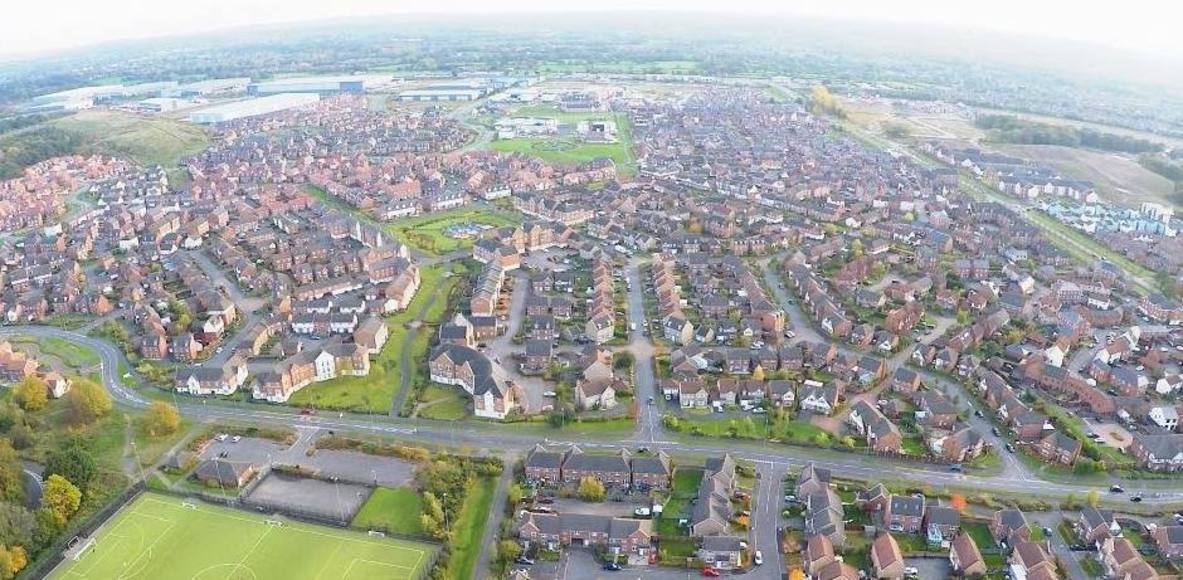
The social life of Buckshaw Village is built rather than inherited. That can be an advantage. It allows residents to shape traditions and networks without the weight of old divisions. It can also be harder, because there is less of a default civic structure.
In practice, community life often centres on the institutions that exist: schools, sports clubs, faith groups, resident-led events, and online neighbourhood forums that have become a modern substitute for the village noticeboard. These channels help people share information quickly, from lost pets to roadworks, but they can also amplify tensions, particularly around parking, noise and anti-social behaviour.
One of the quieter achievements of a place like Buckshaw is when it develops a sense of mutual recognition. That does not require everyone to be friends, but it does require that people feel the area is shared: that green spaces are cared for, that public areas are respected, and that complaints can be resolved without a spiral of blame.
Buckshaw’s challenge, common to many new settlements, is to avoid becoming merely a collection of housing clusters. Community is fostered by repeat encounters and shared spaces. The more those spaces work—safe crossings, maintained parks, accessible facilities—the easier it is for the village to feel coherent rather than segmented.
Safety, policing and the everyday perception of risk
Safety is one of the first questions people ask when considering a move. Buckshaw Village tends to be perceived as relatively safe, in part because it is newer, more open in design, and busy with families. Street lighting, clear sightlines and regular pedestrian movement can contribute to that perception.
But no area is immune to crime or anti-social behaviour, and the key issue is often not headline crime but everyday nuisances: vehicle-related issues, petty vandalism, noise, and occasional disorder around public spaces. These problems can feel sharper in a newer place because expectations are high and because residents may have chosen the area specifically for stability.
Policing levels and response times are shaped by wider pressures. Lancashire, like other forces, has faced resource challenges and shifting priorities. Residents’ experiences therefore vary, and perception can be influenced by social media, which can make isolated incidents feel like trends.
The design of the built environment matters here too. Parking arrangements, alleyways, the placement of play areas, and the presence of “dead” corners can affect how safe people feel. A well-used park is often safer than an empty one; a street where people know each other’s routines is often calmer than one with high turnover.
House prices, renting and the cost of joining the village
Housing affordability is a central issue across the UK, and chorley buckshaw village sits within that national story. Modern homes with good transport links command strong demand, and demand pushes prices. For first-time buyers, the difficulty is often not just the headline price but deposits, mortgage rates and the competition for the most desirable streets and property types.
Renting is part of the local mix, and the experience can be uneven. Some renters appreciate the modern stock and the location; others face the insecurity common in the private rented sector, where tenancy terms and rent rises can make long-term planning difficult. In areas with high demand, the imbalance of power between tenant and landlord can be more pronounced.
There is also a broader point about value and expectation. Newer homes can come with management arrangements, service charges in some cases, and rules about communal areas. For some residents, that is acceptable as a trade-off for maintained public spaces; for others, it feels like a layer of cost and complexity that older streets do not have. The details matter and are often not fully appreciated until people have lived with them for a few years.
The housing market also affects the village’s social stability. High turnover can make it harder to build community, while a settled population can strengthen local networks. The balance between starters, movers and long-term residents will shape Buckshaw’s next decade as much as any physical development.
Planning pressures: growth, traffic and the limits of infrastructure
Buckshaw Village’s very success creates pressure. When an area is popular, more housing follows, and each new phase becomes a test of whether infrastructure keeps up. Traffic is the most visible symptom. Even with a railway station, many daily journeys remain car-based, and junctions that were adequate at one population level can become pinch points as numbers rise.
School places, GP capacity and leisure provision are less visible until they become problems. Waiting lists, crowded classrooms and difficulty securing appointments can erode confidence quickly. The challenge for local authorities is that infrastructure often lags behind housing because funding mechanisms, delivery timelines and political cycles do not align neatly.
There is also the question of design quality. Later phases of large developments can be tempted towards higher density and tighter margins. Residents may notice this as smaller gardens, narrower streets, fewer trees or reduced parking. Whether that is true in each case depends on the specifics, but the perception matters. It feeds into the local debate about what kind of place Buckshaw should become: a genuinely balanced settlement or simply an efficient housing site.
Planning decisions also interact with neighbouring communities. Euxton, Chorley and Leyland each have their own concerns, and what happens in Buckshaw affects them through traffic flows and service demand. Regional planning is, in reality, a negotiation between places with different identities and priorities.
What Buckshaw Village tells us about modern England
Buckshaw Village is not unique, but it is instructive. It shows how Britain has attempted to meet housing need through large-scale redevelopment, particularly on brownfield land. It demonstrates the strengths of masterplanning when it includes transport and green space. It also exposes the persistent weaknesses: the tendency for social infrastructure to feel slightly behind, the dependence on cars even in relatively well-connected places, and the struggle to create a deep sense of place quickly.
It also reflects a particular mood of contemporary life. Many residents want a home that feels orderly, safe and practical, with access to work and schools. They are willing to trade some of the character of older streets for reliability and convenience. At the same time, people still crave community and local identity, and those cannot be built overnight, however carefully a development is designed.
For Chorley itself, Buckshaw raises questions about the relationship between new development and older town centres. If enough people live in modern edge settlements, what happens to the social and economic life of traditional centres? Some of the answer lies in policy, but some lies in habit: whether residents choose to spend time and money locally, whether they feel the town centre is part of their identity, and whether the town centre adapts to changing expectations.
Conclusion: a place still being made
Chorley buckshaw village is, in the most literal sense, a place made from change. It took land with a heavy industrial history and turned it into a modern settlement with homes, schools, parks and transport links that many parts of Britain would envy. It offers a particular kind of stability and convenience, and it has become a significant part of the wider Chorley area rather than an afterthought on the map.
But Buckshaw is not finished, even if many streets look complete. Its long-term success will depend on how it handles the pressures that come with popularity: traffic, service capacity, housing affordability and the slow work of building a shared identity. New places can feel anonymous until the accumulation of ordinary life gives them texture. That texture is forming here, year by year, in the routines of residents who have made a planned village into a lived-in one.