Rotton Park Birmingham rarely features in the way Birmingham talks about itself. It is not a flagship regeneration district with a new name and a glossy masterplan. It is not a Victorian showpiece like neighbouring Edgbaston, nor a shopping destination in the way the city centre is. Yet for many Brummies it is a known quantity: a pocket of inner west Birmingham defined by strong street grids, late-19th- and early-20th-century housing, and the steady presence of Edgbaston Reservoir at its edge.
Search for rotton park birmingham and you are likely to be trying to place it. Is it part of Edgbaston? Is it near the Hagley Road? What is it like to live there? The answers sit somewhere between geography and perception. Rotton Park is close to everything that makes Birmingham feel like a major city—universities, hospitals, offices, nightlife—yet it also carries the marks of an older, more utilitarian urban Birmingham: homes built for clerks and skilled workers, local shopping parades, and streets designed when walking and tram travel were normal.
It is also an area in transition. Like many inner suburbs, Rotton Park has absorbed waves of migration and changes in housing tenure, and it now sits under familiar pressures: rising demand for rental property, student spillover, the tug of short-term lets, and the long-term challenge of maintaining older housing stock. The story of Rotton Park is not one of sudden transformation. It is a quieter story about how a city neighbourhood adapts, sometimes well and sometimes awkwardly, as Birmingham’s economy and population shift.
Where Rotton Park sits, and why its boundaries can be confusing
Rotton Park is in the Ladywood area of Birmingham, a short distance west of the city centre. It sits between the Hagley Road corridor to the south and the Edgbaston Reservoir to the north, with Icknield Port Road and the inner ring road network not far away. The neighbourhood is closely adjacent to Edgbaston, and that proximity has always blurred lines on maps and in conversation.
Part of the confusion is status. “Edgbaston” is a name with a strong association: leafy avenues, the cricket ground, medical institutions, and a certain aspirational Birmingham identity. Rotton Park is more mixed in both housing and income. Some properties are substantial; others are modest terraces converted into flats. Yet from a practical standpoint, Rotton Park is extremely well placed. It is close to the city centre without being in it, and it is close to the green and blue space of the reservoir, which gives it a breathing space unusual for an inner suburb.
The neighbourhood’s street pattern helps define it. Rotton Park has a recognisable grid of terraced streets, with a network of main routes that carry traffic towards the centre, Harborne and Bearwood. That grid creates a sense of enclosure and local identity. You can be only a few minutes from a busy arterial road and still find quiet residential streets with mature trees and long-established communities.
A brief history: from industrial Birmingham to an inner suburb
To understand rotton park birmingham you have to place it in the city’s longer expansion. Birmingham’s growth in the nineteenth century produced a ring of inner suburbs that were neither slums nor elite enclaves, but somewhere in between. They housed the expanding workforce of a city built on manufacturing, commerce and administration. Rotton Park developed during this period, shaped by the need to accommodate people who worked in the city and wanted a degree of stability and respectability in their housing.
The area’s housing reflects that. Much of it is late Victorian and Edwardian: terraces and semi-detached houses, often built with red brick, bay windows and small front gardens where space allowed. This was practical housing, but it was not the cheapest kind. It was meant for households with regular income, sometimes multi-generational, sometimes with lodgers. Over time, these properties have been divided, extended and adapted, reflecting shifts in family size, renting patterns and economic pressure.
Rotton Park’s development was also shaped by transport. Birmingham’s tram and bus networks historically made inner suburbs viable, linking them to employment and shopping. The area’s closeness to the centre has always been one of its advantages. As the city moved into the car age, roads like Hagley Road became more dominant, and the balance between residential calm and traffic intensity became a defining feature of local life.
Edgbaston Reservoir: the water that changes the feel of the neighbourhood
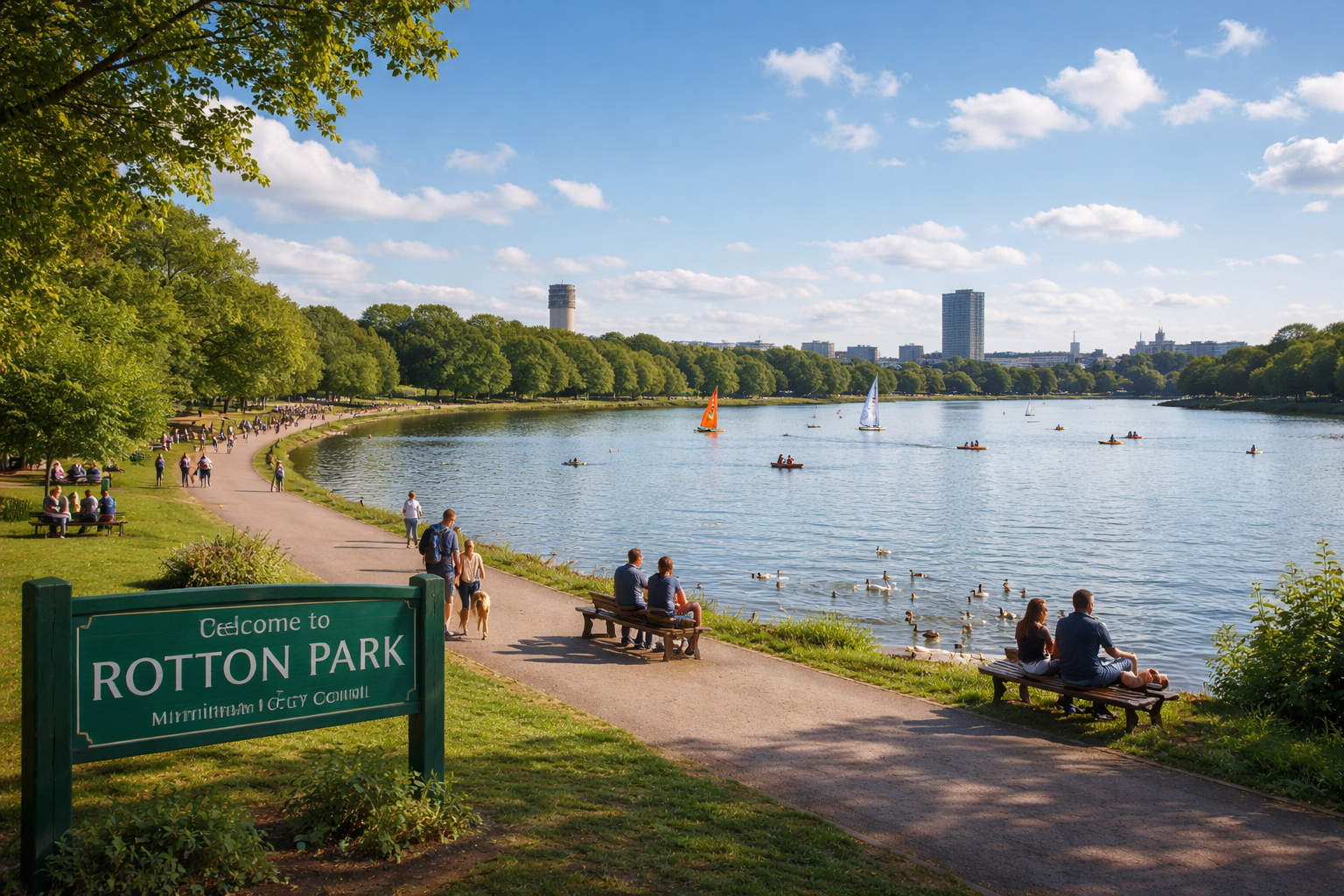
Edgbaston Reservoir, sometimes still referred to locally as “Rotton Park Reservoir”, is the physical feature that most clearly distinguishes the area. Created in the early nineteenth century as a feeder reservoir for the Birmingham Canal Navigations, it began as infrastructure rather than amenity. Its purpose was to supply water to the canal system, supporting the transport network that underpinned Birmingham’s industrial economy.
Over time, the reservoir’s role in everyday life changed. The canals became less central to freight, and the reservoir became something else: a large open body of water on the edge of dense housing, a place with wildlife, walking routes and a sense of sky that can be hard to find in the inner city. It is not a manicured park lake. It retains an industrial logic in its shape and edges. But that is part of its character. It looks and feels like Birmingham: engineered, functional, and now repurposed as a space people value for recreation and calm.
For Rotton Park residents, the reservoir is a local asset that affects daily routines. It offers a route for walking and running, a place to sit, and a visual break from brick and tarmac. It also shapes property perception. Streets closer to the water can feel more desirable, not because they are wealthy by default, but because access to open space carries its own value.
There are, inevitably, practical issues too. Waterside spaces bring debates about maintenance, safety and anti-social behaviour, and they require management that balances wildlife with human use. But the reservoir’s presence gives Rotton Park a feature that many comparable inner suburbs lack: a large, continuous landscape element that anchors local identity.
Housing and tenure: terraces, conversions and the realities of the rental market
Rotton Park’s housing stock is one of its defining characteristics. The area includes substantial Victorian houses and long terraces that were built for a different era of household life. Many of these properties have been converted into flats or houses in multiple occupation over the years, reflecting Birmingham’s changing demographics and the steady demand for relatively central accommodation.
This makes Rotton Park varied street by street. Some roads have well-kept family homes and long-term owner-occupiers. Others have a higher turnover of tenants, including students and young professionals, particularly given the area’s access to the University of Birmingham and to the city centre. The mix is not inherently a problem; it can keep a neighbourhood lively and economically mixed. But it does create pressures: waste management, parking, property maintenance, and the challenge of building community cohesion when residents are transient.
The wider Birmingham rental market also plays a part. As house prices and rents rise across the city, areas like Rotton Park become attractive because they offer space and location without the premium attached to the most fashionable postcodes. That demand can be a double-edged sword. It can bring investment into tired housing stock. It can also accelerate conversion and densification in ways that strain local infrastructure and change the feel of streets.
The core issue for many inner suburbs is balance: enough stability to sustain local networks, and enough flexibility to accommodate newcomers and changing household needs. Rotton Park lives inside that balancing act.
Community profile: migration, institutions and everyday multicultural Birmingham
Like much of Birmingham, Rotton Park reflects the city’s long history of migration and settlement. Communities have moved into the area over decades, and the neighbourhood’s character has been shaped by that diversity. Places like Rotton Park often tell a more accurate story of Birmingham than the city’s stereotypes do: a working urban area where people of different backgrounds live close together, use the same streets and shops, and negotiate shared space in ordinary ways.
Local institutions matter here. Places of worship, community groups, schools and small businesses often do the quiet work of maintaining cohesion in areas where formal civic presence can feel distant. Rotton Park’s proximity to major Birmingham institutions also affects its social geography. The city’s hospitals, universities and office districts bring people into the area who may not have grown up in Birmingham but who settle because the location makes daily life workable.
This produces a community that is both rooted and fluid. Long-term residents and newer arrivals share streets, and the area’s identity is therefore practical rather than performative. Rotton Park is not constantly reinventing its brand. It is, in the best sense, ordinary Birmingham: resilient, mixed and shaped by everyday needs.
Transport and movement: close to the centre, exposed to traffic

Location is Rotton Park’s advantage, but it also means the area sits within Birmingham’s traffic system. The Hagley Road corridor is a major route into and out of the city, and surrounding roads carry a steady flow of vehicles. Residents benefit from bus routes and the ability to reach the centre quickly, but they also experience the downsides: congestion at peak times, noise, and air quality concerns that are not evenly distributed across the city.
For people living in rotton park birmingham, travel is often a blend of modes. Many rely on buses for city centre access, especially those without cars. Others walk or cycle, though Birmingham’s cycling infrastructure is still uneven and can feel fragmented as routes intersect with heavy traffic. The reservoir paths offer a more pleasant environment for walking and exercise, but they are not always direct for commuting.
Parking is a persistent inner suburb issue. Streets built before mass car ownership were not designed for multiple vehicles per household. As more properties are divided into flats, parking demand rises without new space being created. This can become a source of tension between long-term residents and newer tenants, and it is one of the ways housing market shifts are experienced at street level.
Local amenities and the question of “place”
Rotton Park does not have a single, obvious high street in the way some neighbourhoods do. Its amenities are distributed: small local shops, takeaways, service businesses, and easy access to larger centres nearby. That can be convenient, but it also means the area can feel like a residential zone rather than a destination.
This is not necessarily a weakness. Many people choose Rotton Park precisely because it is close to Edgbaston, Harborne and the city centre, where larger amenities are concentrated. The neighbourhood’s appeal is often about proximity rather than self-sufficiency. You can get into town quickly, but you can also come home to quieter streets and, if you are near the reservoir, a sense of space.
Still, the lack of a strong local centre can affect community feeling. Neighbourhoods cohere when there are shared places where people naturally meet: a parade of shops, a park, a library, a community hall. Rotton Park has the reservoir as a shared space, and that is significant. But as with many inner suburbs, maintaining a sense of “place” depends on the health of small amenities and on whether streets feel safe and pleasant to use.
Planning and pressure: what change looks like in an inner suburb
Rotton Park’s challenges are typical of Birmingham’s inner ring. Older housing needs investment; private renting is high in some pockets; streets face traffic pressure; and the area sits close to major employment centres that continue to grow.
Planning debates tend to focus on conversion, density and the quality of development. When large houses are subdivided, questions arise about standards, noise, refuse storage and whether the street can absorb increased occupancy without losing liveability. When new-build projects appear, the concerns are often about scale, parking, and whether public space is being improved alongside private development.
There is also a broader Birmingham context. The city has committed to accommodating growth and addressing housing need, while also dealing with constrained budgets and high demand for services. Neighbourhoods like Rotton Park can feel the effects of that squeeze. Small declines in service provision—street cleaning, maintenance, enforcement—can have outsized impacts on how an area feels.
The most constructive conversations about Rotton Park tend to centre on practical improvements: safer crossings near main roads, better waste management, clearer routes for walking and cycling, and the maintenance of the reservoir environment. These are not glamorous interventions, but they are the kinds of changes that make inner suburbs more liveable.
Conclusion
Rotton Park is not Birmingham’s loudest neighbourhood, but it is one of its more revealing ones. It sits close to the city centre, shaped by Victorian housing, modern renting patterns and the daily reality of traffic. It is anchored by Edgbaston Reservoir, a piece of industrial infrastructure that has become a valuable shared landscape. It is also a place where Birmingham’s ordinary multicultural life plays out, not as a slogan but as a practical fact.
To understand rotton park birmingham is to understand an inner suburb as it actually is: neither a pristine enclave nor a district in crisis, but a mixed, adaptable area dealing with the same pressures facing many UK cities. Its strengths are location, housing character and access to open water. Its vulnerabilities are the wear and tear of older stock, the strains of densification, and the constant negotiation with the road network that runs past its door. If Birmingham’s future is about making existing neighbourhoods work better rather than endlessly expanding outward, Rotton Park is exactly the sort of place where that future will be decided.