Brill is the sort of English place-name that makes people smile before they know anything about the place. In modern slang it sounds like a compliment; in reality it is a hilltop village with a long, workmanlike history, set among fields and woods close to the Buckinghamshire–Oxfordshire border. To search for brill buckinghamshire uk is usually to look for something straightforward: where it is, what it’s like, what makes it distinctive, and how it fits into the wider map of Aylesbury Vale, Bicester, Thame and the commuter belt beyond.
What you find is a village shaped by its geography. Brill sits on a rise above surrounding lowland farmland, its skyline marked by a windmill and a church tower, and its lanes falling away into quiet countryside. It is not a showpiece estate village and it is not a market town. It is a working settlement that has had periods of significance well beyond its size, from its association with royal hunting and forest administration to its unexpected role in railway history through the Brill Tramway.
Like many villages in this part of the country, Brill’s present is defined by a mixture of continuity and change. The old patterns are there in the buildings, the footpaths and the field boundaries. The newer patterns appear in commuting habits, house prices, planning debates and the steady rebalancing of rural communities across the South East. Brill is still recognisably itself, but it is no longer insulated from wider pressures.
Where Brill sits, and why the hill matters
Brill lies in the north of Buckinghamshire, a few miles from the Oxfordshire boundary and within reach of Bicester, Thame and Aylesbury. It is not part of the Chilterns in the strict sense, though it shares some of the same “edge-of-the-south” character: attractive countryside, good road access, and the feel of a place that is rural but not remote.
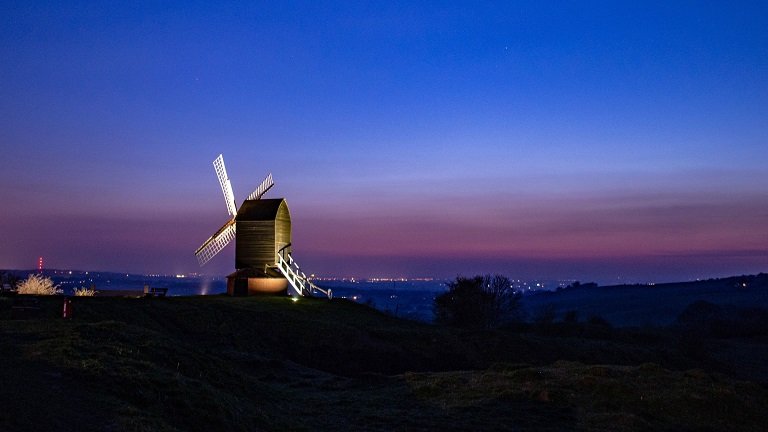
The village’s defining physical feature is Brill Hill. On a clear day the elevation gives you the sense of being perched above the surrounding countryside rather than embedded within it. That height has always mattered. It offered defensibility in earlier periods, practical visibility for a community dependent on land, and later a prominent position for the windmill that still stands as one of Brill’s best-known landmarks.
The hill also makes Brill feel separate even when it is only minutes from larger roads. Approaches are by lanes that climb gently, and the village arrives in stages: first the edge of housing, then the core streets and older buildings, then the open views beyond. It is an important distinction. Some villages in this part of England have been swallowed by sprawl; Brill has remained visually distinct because the hill and surrounding farmland still give it a clear boundary.
That does not mean it is isolated. The area is threaded by minor roads that connect to larger routes, and day-to-day life reflects the pull of nearby towns. But in terms of landscape, Brill still reads as a place on its own hill, not a suburb waiting to happen.
From royal manor to rural settlement: Brill’s older story
Brill’s history is bound up with the royal and administrative geography of medieval and early modern England. This was a region of forests in the historical sense: not necessarily dense woodland everywhere, but legally defined tracts where hunting rights, timber use and grazing were regulated. The wider Bernwood area, which once covered parts of what is now Buckinghamshire and Oxfordshire, was significant in that system.
Royal manors, hunting lodges and the bureaucracy of forest law were not abstract matters. They shaped where people lived, what they could do with land, and how communities were governed. Brill’s elevated position and its location within a historically managed landscape help explain why it appears repeatedly in records long before it became a quiet village in a modern county.
It is important not to overstate the glamour of this past. Royal connections in rural England often meant obligation as much as opportunity. Forest administration could restrict local use of resources, and a community’s relationship with a royal manor could involve rents, duties and legal constraints. Yet these ties did place Brill within a network of power and attention that many small villages never had.
Over time, as the strict medieval forest system faded and land use patterns evolved, Brill became what it looks like today: a rural settlement with a mix of older houses, later infill, farms nearby, and a landscape that bears the marks of centuries of management.
Farming, clay and local craft: the hidden economies of a Buckinghamshire village
When people picture rural Buckinghamshire, they often imagine large arable fields, hedgerows, and a countryside shaped by farming rather than by industry. Brill fits that picture in many respects, but its local economy historically drew on more than agriculture alone.
The geology around Brill includes clays and sands that have long been valuable for building materials and domestic goods. In many English villages, clay was dug and used locally for bricks, tiles and pottery, sometimes in small operations that left few visible traces once they closed. Such work rarely produced grand ruins; it left pits, altered ground levels, and a local tradition of making and building.
These minor industries mattered because they diversified rural livelihoods. Farming can be seasonal and vulnerable to bad years; local extraction and craft provided additional income. They also influenced the look of the village. The building materials available locally, and the skills present in the area, shape the character of walls, chimneys and outbuildings.
Brill also sits in a wider region where lace-making and other cottage industries once formed part of rural life, particularly in Buckinghamshire and neighbouring counties. Those histories can be difficult to see in the landscape, but they are part of how villages functioned: households combining farm labour with craft work, women’s labour contributing to income in ways that formal histories often undercount, and local markets connecting rural communities to wider demand.
If you want to understand brill buckinghamshire uk beyond its postcard view, this is the texture to keep in mind. The village was never just scenery. It was a working place in which people cobbled together livelihoods from land, materials and skill.
The Brill Tramway: why a small village became a byword for railway oddity
Brill’s most famous modern historical association is the Brill Tramway, a light railway that connected Brill to the wider rail network via Quainton Road. It has become a touchstone in British railway history, not because it was large or profitable, but because it was distinctive: a rural line with an unusually informal air, later absorbed into the Metropolitan Railway’s world and therefore linked, improbably, to the story of London’s suburban expansion.
The tramway began as a practical local scheme and evolved through changing ownership and railway politics. In the popular imagination it is often remembered as charming, eccentric and faintly improbable, running through countryside at a pace that became the stuff of anecdote. That image is not entirely unfair, but it can obscure the hard logic behind such lines.
Rural railways were about connection. They moved goods, brought in supplies, and offered people access to towns and services. For villages like Brill, a rail link was not a quaint novelty; it was a potential lifeline in a period when horse-drawn transport limited what could be moved and how quickly. Even a slow line could matter.
The tramway’s later reputation also speaks to the romance that railways acquired once they began to disappear. When lines closed, communities lost a mode of transport and a piece of local identity. The Brill Tramway’s closure in the 1930s placed it early in the story of rural rail contraction, long before the Beeching era became shorthand for line closures. That is one reason it retains such a clear place in railway folklore.
For the village itself, the tramway era left a more subtle legacy. The alignment and the sense of where connection once existed remain part of local memory. It also reinforced Brill’s position as a village oriented both to its immediate countryside and to the wider region.
Windmill, church and streetscape: what gives Brill its character
Brill’s built environment is one of its strengths, though it is better described as coherent than grand. The village is not dominated by a single estate or a uniform architectural style. Instead it has the layered look of a settlement that has grown over centuries, with older houses sitting alongside later additions, and with materials that reflect local availability as much as fashion.
The Brill windmill is the standout landmark. Windmills in England are often the survivors of a once-common rural technology, and when they remain they tend to carry a symbolic weight beyond their practical history. In Brill, the windmill’s position on the hill gives it visibility and makes it a reference point. It also anchors the village in the long agricultural story of grain, milling and the management of food supply.
The parish church, too, plays its role in the village’s silhouette and identity. Churches in rural Buckinghamshire vary greatly in scale and ornament, but their presence is consistent: a reminder that parish life once structured community rhythms in a way that is less dominant now. Even for residents who do not attend services, the churchyard, bells and seasonal events can still form part of the village’s sense of continuity.
What tends to define Brill most, though, is the streetscape. The village’s lanes and roads follow the hill’s logic rather than a grid. That produces corners, slopes and changing sightlines, the opposite of the planned uniformity seen in some newer developments. It is this irregularity, combined with older buildings and green edges, that gives Brill its particular feel.
Living in Brill today: services, commuting and community balance
Modern rural life in this part of England is often a negotiation between localism and dependence on nearby towns. Brill is no exception. People who live in brill buckinghamshire uk do not generally expect every service to be available within walking distance, but they do expect a functioning village: a sense of community infrastructure, local networks, and reasonable access to essentials.
Many residents rely on nearby towns for supermarkets, healthcare and broader retail. Employment patterns reflect the region’s economics. Some people work locally, including in trades and services, but many commute, whether to Aylesbury, Bicester, Oxford, Milton Keynes or London. Remote and hybrid working have added another layer, changing how some households experience the village during the week and increasing the importance of reliable broadband and mobile coverage.
That shift affects village life in subtle ways. A commuter village can feel empty during working hours; a village with more home working can feel busier and more socially connected in daytime. It also changes the local economy. Increased daytime presence can support local services; it can also intensify parking pressure and raise expectations for amenities.
Demographically, villages like Brill face a familiar tension. They can attract families looking for space and schools, but they can also become expensive, making it harder for younger adults raised locally to remain. The result can be a gradual ageing, punctuated by bursts of new family settlement as new housing becomes available. How that balance plays out depends on planning, affordability and the broader regional job market.
Brill’s community life is likely to be strengthened by the very factors that once made villages resilient: local groups, shared spaces, and the informal ties that form in small places. But these do not maintain themselves automatically. A village that grows without expanding its social infrastructure can become fragmented, with newcomers living alongside long-term residents without much interaction. The healthiest rural communities tend to be those that find ways to bridge that gap, through institutions that feel genuinely shared rather than preserved for tradition’s sake.
Planning pressures: growth, conservation and the rural South East
No village in Buckinghamshire sits outside the planning debate. The county’s position within the wider South East housing market means demand is persistent, and villages near transport corridors or attractive landscapes often face particular pressure. Brill’s hilltop identity and its relative proximity to expanding centres such as Bicester make it a place where questions of development and protection naturally arise.
The planning challenge is rarely framed simply as “build or don’t build”. It is about what kind of growth is appropriate, where it should sit, and whether infrastructure is keeping pace. Roads and lanes in and around Brill were not designed for high traffic volumes. Increased car ownership, delivery traffic and commuter flows can turn rural lanes into pressure points, raising concerns about safety, noise and maintenance.
There is also the question of landscape character. Brill’s setting depends on the relationship between the built area and the surrounding farmland and woodland. If development pushes out in ways that break that relationship, the village risks losing the visual distinctness that makes it what it is. On the other hand, a total freeze on development can lock out local families and essential workers, leaving the village increasingly exclusive and less socially balanced.
Sensible planning in villages like Brill tends to focus on integration: housing that connects to existing streets, safe walking routes, and a mix of sizes that reflect actual local need. It also involves attention to biodiversity and water management, particularly as climate patterns change and as rural drainage systems face new stress.
The countryside around Brill: footpaths, woods and the managed landscape
The area around Brill is rich in the kind of accessible countryside that many people value precisely because it is not spectacular. It is a working landscape: fields, hedgerows, woods, and a network of paths that connect villages and viewpoints.
Public footpaths and bridleways are important here, both practically and culturally. They offer routes for walking and riding that are not dependent on narrow roads, and they reinforce a sense of continuity with older patterns of movement. They also bring responsibilities for visitors and residents alike: respecting crops, livestock and gates, and understanding that access exists alongside farming, not instead of it.
Woodland in this part of Buckinghamshire can feel particularly significant because it hints at the older Bernwood landscape. Even where ancient woodland has been reduced or fragmented, the presence of copses and tree belts helps define the local character. Wildlife corridors, field margins and hedgerow management matter more than people often realise, not only for biodiversity but for the feel of the place. A well-maintained hedge is not simply a boundary; it is part of the visual grammar of the countryside.
For those trying to understand brill buckinghamshire uk as a place to live or to know, this surrounding landscape is not an extra. It is one of the village’s key assets and one of the reasons its planning debates carry emotional weight.
Conclusion
Brill is a small Buckinghamshire village with a surprisingly wide historical footprint. Its hilltop position shaped its settlement pattern and gave it a landmark windmill; its connection to royal and forest history placed it in older networks of power; its local materials and rural industries contributed to its built character; and its association with the Brill Tramway gave it a place in national railway lore that far exceeds its size.
In the present, brill buckinghamshire uk is best understood as a working rural community navigating modern pressures: commuting, housing demand, infrastructure limits and the desire to maintain a coherent village identity. It is not a preserved relic, and it is not a blank slate. It is a place where the past is visible in the layout of lanes and the silhouette of the hill, and where the future will depend on how carefully growth, services and landscape are managed in the years ahead.