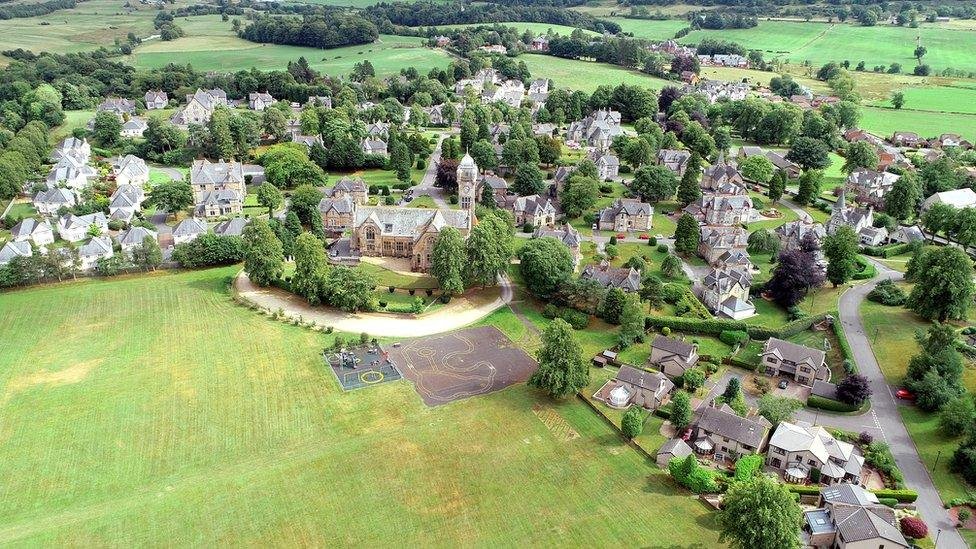
On the road between Bridge of Weir and Port Glasgow, the landscape changes quickly. Suburban edges give way to wooded slopes, and then—almost without warning—there is a settlement that looks as if it has been lifted from another century. Cottages of warm red sandstone sit back from the road. There is a church with a prominent spire, a cluster of institutional buildings, broad lawns and mature trees. It feels planned, composed, even slightly separate from the ordinary sprawl of the Central Belt. This is Quarriers Village, a place whose outward calm masks an intense and complicated history.
For many people, quarriers village scotland is a name encountered in passing: on signposts, in local conversation, perhaps in the context of the charity that still operates there. Yet it is more than a village with a distinctive look. It was conceived as a social intervention in stone and timber: a purpose-built community designed to house and raise vulnerable children away from the city, at a time when Scotland’s industrial wealth sat alongside extreme urban poverty.
Quarriers Village has since moved through several identities. It began as a Victorian orphan homes project, expanded into a major institution, and then steadily transformed as the twentieth century changed what the country expected of child care, disability support and welfare. Today it is both a residential community and the hub of a modern social care charity. To understand it properly is to accept that it cannot be reduced to either nostalgia or condemnation. It is a place where good intentions, hard realities, faith-driven discipline, and evolving standards of care meet in a single landscape.
Where Quarriers Village is, and what survives today
Quarriers Village lies in the west of Scotland, close to the village of Bridge of Weir and within commuting distance of Glasgow and Paisley. Historically it sits in Renfrewshire; in present-day local government terms it is associated with Inverclyde. That ambiguity of “where it belongs” is not only administrative. It reflects the village’s original purpose as an institution deliberately placed on the edge of the city: close enough to supply resources and oversight, but far enough to claim the benefits of country air and distance from urban deprivation.
Physically, the village still reads as a planned settlement. The core is a group of substantial nineteenth-century buildings—church, cottages, halls and administrative structures—arranged within a landscape that was designed to feel orderly and wholesome. Not all of the original functions remain, and some buildings have been adapted for new uses, but enough survives to convey what the founders were trying to create: a self-contained environment, part domestic, part institutional, that could stand as an alternative to the workhouse and the crowded tenement.
The place is also still lived in. That matters. Quarriers Village is not simply a historic site, and it is not solely a workplace. It is a community with residents who have no reason to want their streets treated as a museum. At the same time, the built form is distinctive and historically important, and the village’s history is inseparable from Scotland’s wider story of welfare, religion and social reform.
William Quarrier and the Victorian impulse to build solutions
Quarriers Village is inseparable from the figure of William Quarrier, a man whose life mirrors some of the contradictions of Victorian philanthropy. He emerged from modest beginnings and made money through business in Glasgow, then turned his attention to charitable work among the city’s poor. In the late nineteenth century, Glasgow was one of the great industrial centres of the British Isles, producing wealth and drawing in labour, but also generating overcrowding, disease, insecure work and early death. Children, in particular, were exposed to risk: orphanhood, neglect, malnutrition, exploitation and homelessness were not marginal phenomena but part of the texture of city life.
Charitable intervention filled gaps that the state either could not or would not address. It did so in ways shaped by the values of the time. The aim was often twofold: to relieve immediate distress and to produce morally upright, employable citizens. Victorians argued fiercely about how to do that. Some believed in institutional discipline. Others promoted fostering and smaller-scale domestic arrangements. Many philanthropists, including Quarrier, were motivated by a Christian sense of duty and a belief that environment could mould character.
The decision to create a village for children in the countryside was therefore not an eccentric whim. It sat within a broader movement towards “cottage homes”, designed to imitate family life more closely than the large barrack-like institutions that had come to symbolise older forms of poor relief. If the city was seen as a place of vice and contamination, the countryside was framed as healthful and corrective. Quarriers Village was a physical expression of that belief.
The “cottage homes” model: domestic ideal, institutional reality
The defining innovation of Quarriers Village was its structure. Rather than housing large numbers of children in one building, the village was built around multiple cottages, each intended to function as a household. The language used at the time emphasised family, home and nurture. Children would live in smaller groups, supervised by adults who were meant to provide care and stability. In theory, it was a move away from the impersonal institutional model.
In practice, it was both domestic and institutional. The cottages may have been smaller, but they were part of a system with rules, hierarchy and routines. The “village” was designed to be self-sufficient and controlled, with education, work training and religious instruction integrated into daily life. It offered shelter, food and a route into employment for children who might otherwise have faced grim alternatives. It also required conformity to the moral and social expectations of its founders.
This dual character is important when assessing Quarriers Village today. It is easy to view the cottage homes model as a simple improvement on the workhouse, and in many respects it was. It is also easy to judge it solely by modern standards and find it wanting, and in certain respects it was. A serious understanding requires both perspectives: to recognise the harsh environment it sought to counter, and to acknowledge the ways in which any large-scale child-care institution can become rigid, controlling, and vulnerable to failures of oversight.
Life in the village: schooling, labour and belonging
For the children who lived in Quarriers Village, daily life was structured. The village provided schooling and training, and it aimed to equip children for adult work. The Victorian and Edwardian mindset did not separate education from preparation for service, trade or domestic labour. Many charitable homes, across Britain, saw their mission as turning vulnerable children into disciplined workers able to support themselves.
In a place like Quarriers Village, training would have been shaped by gender expectations of the era. Boys and girls were commonly channelled into different kinds of work, reflecting the labour market and social norms. Alongside education, there would have been chores and routines that kept the village functioning, with children participating in the maintenance of their environment. To modern eyes, this can look like exploitation; to contemporaries, it could be framed as character-building and practical preparation. Both interpretations can contain truth, depending on the extent of the work, the conditions, and the options available.
Belonging is harder to measure than routine. Some former residents of institutional child care describe stability, friendships and a sense of order that they did not experience elsewhere. Others recall loneliness, harsh discipline or a feeling of being set apart from ordinary society. A village created specifically for children in care could provide safety; it could also deepen the sense of difference, particularly as children grew older and became aware that their lives were not like those of families beyond the village boundaries.
Quarriers Village, like many historic institutions, therefore carries multiple personal histories. It is not a single story. It is an accumulation of individual experiences shaped by the same built environment and the same organisational mission.
Religion, morality and the discipline of “rescue”
Faith was not an accessory in the creation of Quarriers Village. It was a driving force. Victorian philanthropy in Scotland was often closely intertwined with Protestant religious culture, including strong ideas about temperance, self-help, duty and moral reform. The village church stands as architectural evidence of that centrality: a prominent building that asserted what the institution saw as its spiritual foundation.
Religious instruction and worship were typically woven into daily routines. To supporters, this offered comfort, community and moral guidance. To critics, it could also represent control and the imposition of a narrow worldview on children with little choice in the matter.
This tension is not unique to Quarriers Village; it is part of the wider history of “rescue” institutions. The language of rescue implies both compassion and authority. It assumes that the rescuer knows best, and that the rescued must be remade. For children who had already experienced upheaval and loss, the offer of structure could be stabilising. But it could also be psychologically demanding, especially when discipline was strict and when affection was conditional on obedience.
In the twenty-first century, any honest discussion of historic child-care institutions must also acknowledge a broader reckoning. Across Britain and Ireland, investigations and testimonies have exposed failures in institutional settings, including neglect and abuse, sometimes systemic, sometimes individual, often compounded by secrecy and power imbalances. That context shapes how places like Quarriers Village are viewed now: not merely as heritage, but as part of a history that requires transparency and care in how it is remembered.
Architecture and landscape: a planned community in stone and trees
One reason Quarriers Village remains visually striking is its architectural coherence. The use of red sandstone, the consistent scale of cottages, and the presence of landmark buildings create a sense of intentional design. This was not a settlement that grew haphazardly. It was built to represent an idea: order, stability, moral seriousness.
The landscape was part of that message. Trees, lawns and open space were not simply decorative. They were a claim about health and environment. The nineteenth century saw growing confidence that fresh air and rural surroundings could improve physical and moral wellbeing. In a period when tuberculosis and infectious disease were common in cities, the countryside was associated with recovery and resilience. Quarriers Village embodies that belief in its very layout.
There is also a subtler point. Planned philanthropic communities often used architecture to project legitimacy. A well-built cottage and a dignified church were statements to donors and to the wider public: evidence that money was being used responsibly, and that the institution was creating a “proper” environment for children who might otherwise be stigmatised. The village was, in effect, an argument built in stone.
The long twentieth century: shifting welfare, declining institutions
Quarriers Village did not remain frozen in its founding moment. The twentieth century altered the welfare landscape fundamentally. The rise of state provision, changes in child welfare law, and evolving ideas about family life and children’s rights reshaped what was considered acceptable and effective care.
Large institutions, even those organised into cottage systems, came under greater scrutiny. The assumption that children in care should be raised in sizeable, separate communities began to weaken. Over time, policy and practice moved towards smaller units, fostering and, where possible, support that kept families together. At the same time, the post-war welfare state expanded the role of government, reducing reliance on charitable provision for basic social needs, while charities increasingly shifted towards specialised support and partnership with public services.
For Quarriers Village, this meant transition. The original purpose as a large-scale children’s homes community became less central, and the village adapted. Buildings were repurposed, services changed, and the organisation behind the village evolved from an orphanage model into a broader social care provider.
These changes were not merely organisational. They altered the village’s atmosphere. A place built to house large numbers of children began to function differently as numbers reduced and as new kinds of care and support were delivered. The village became, gradually, less of an all-encompassing institution and more of a mixed community with a charitable presence.
Quarriers today: a charity rooted in place, operating beyond it
The name “Quarriers” now refers primarily to a modern Scottish charity providing a range of social care and support services. While its headquarters and historic heart remain tied to Quarriers Village, its work extends well beyond the village boundaries, reflecting how the organisation has adapted to contemporary needs.
It is significant that the village remains part of the charity’s identity. Many organisations outgrow their original sites or sever ties with them. Quarriers has maintained a tangible link to the place where its mission took architectural form. That continuity offers advantages: a campus-like setting that can support certain services, an established infrastructure, and a physical reminder of the organisation’s origins. It also brings responsibilities, particularly in how the charity handles heritage, community relations and the memory of those who lived there in earlier eras.
For the wider public, this can make quarriers village scotland a slightly unusual place to understand. It is not simply a residential village. It is not simply a workplace. It is a hybrid, where historic fabric, contemporary social care and ordinary domestic life intersect. The success of that intersection depends on management, planning and the everyday mutual respect between residents, staff and visitors.
Heritage versus everyday life: conservation, development and local feeling
Quarriers Village has heritage value, but it is not a sealed heritage site. That creates a familiar tension seen across Britain: how to preserve historic character while allowing a place to function as a living community.
Older buildings require maintenance and adaptation. Accessibility standards change. Energy efficiency expectations shift. The needs of a modern care organisation are not the needs of a nineteenth-century orphan homes system. At the same time, if historic buildings are altered without sensitivity, the coherence that makes the village distinctive can be eroded.
Development pressures add another layer. The west of Scotland has seen changing housing demand, commuting patterns and planning priorities. A village located within reach of Glasgow naturally attracts interest as a residential place, particularly when it has a distinctive built environment and green space. That interest can be positive if it supports sensitive reuse and investment. It can be harmful if it treats the village as a backdrop, ignoring its social history and the practical needs of a community that includes vulnerable people.
Local feeling about such changes is rarely uniform. Some residents value quiet and privacy; others welcome improved amenities and restored buildings. Some prioritise heritage; others prioritise affordability and liveability. The challenge for any place like Quarriers Village is to hold these legitimate interests together without allowing one to erase the others.
Visiting and remembering: how to approach the village respectfully
People often come to Quarriers Village out of curiosity, or because they have a personal connection through family history. Others come because the architecture and setting are striking, or because they are interested in Scotland’s social welfare past. All of those motivations are understandable. The key is to approach the place with an awareness that it is not a theme park.
The village can be appreciated through its streetscape, its church, and the overall planned character. The wooded setting and the sense of separation from surrounding settlements are part of what makes it distinctive. Yet visitors should remember that this is a residential environment, and that parts of the site relate to ongoing care provision. Public access is therefore not universal, and it should not be assumed.
Remembering, too, requires care. It is possible to admire the architectural ambition and the philanthropic energy behind the village while still holding space for the complexities of institutional care. Quarriers Village is a reminder that social problems have long been addressed through a mixture of compassion, control, faith and pragmatism. The buildings do not tell you which elements dominated in any individual child’s experience. They tell you what the institution aspired to be, and what it needed the public to believe.
Conclusion
Quarriers Village is one of the most distinctive planned communities in Scotland, and its distinctiveness is inseparable from the social purpose that created it. Built as a response to urban poverty and childhood vulnerability, it embodied a Victorian belief that environment, routine and moral instruction could reshape lives. Over time, shifting welfare ideas and new expectations of care transformed its role, leaving a place that is at once historic, lived-in and operationally modern.
To understand quarriers village scotland today is to read the village in layers: the philanthropic ambition in its architecture, the institutional past behind its tidy cottages, the personal histories—many unseen—embedded in its streets, and the contemporary work of social care that continues in and around it. It remains a rare example of a social idea built at village scale, and it invites not sentimentality, but serious attention to what Scotland has asked of its charities, its communities and its children.