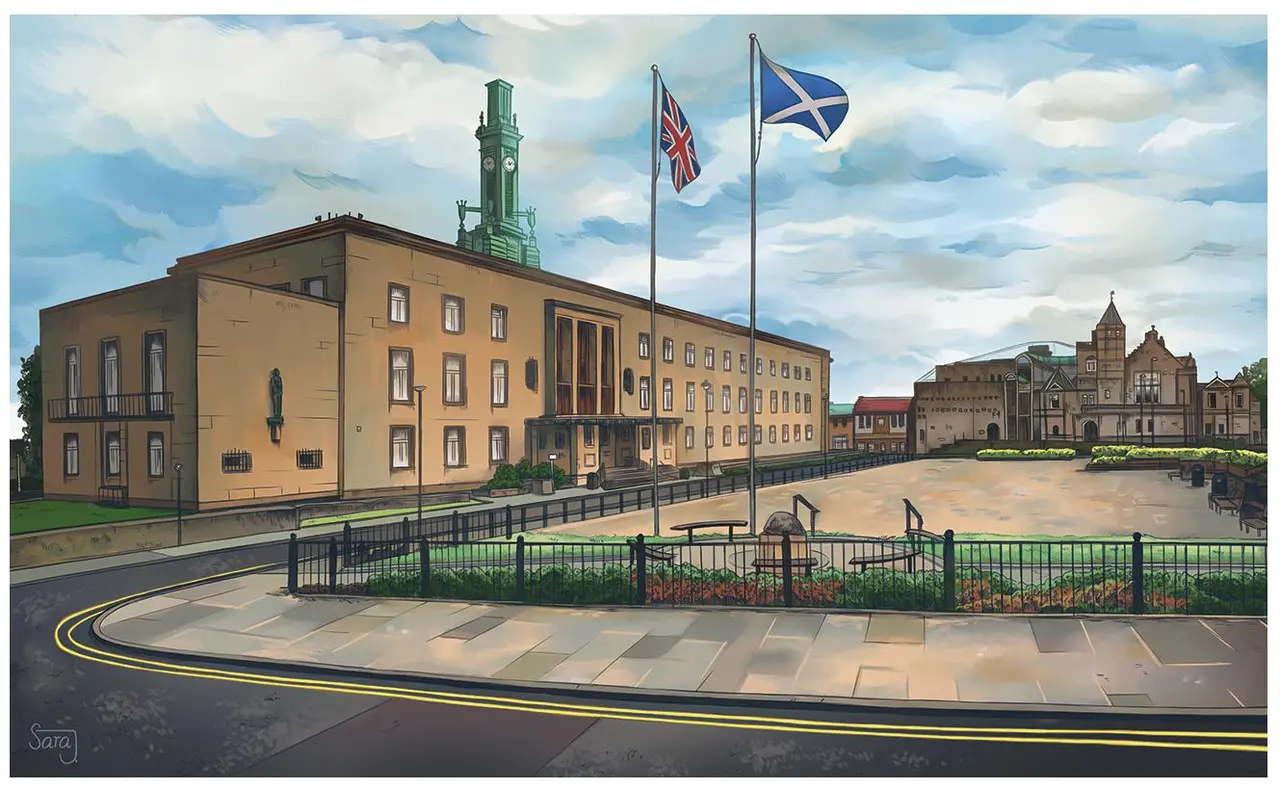
Walk along Kirkcaldy High Street and you quickly understand why locals still speak of the town as the Lang Toun. The road stretches with a kind of stubborn confidence, a main artery that has carried the town’s trade, arguments, celebrations and disappointments for centuries. Amid the shopfronts and the changing fortunes of the centre stands one building that continues to project authority even when it is not actively exercising it: Kirkcaldy Town House.
To some visitors it is simply a handsome old municipal building, the sort of place you photograph without quite knowing why. To others it is practical and personal: a venue for ceremonies, a landmark for directions, a backdrop to marches, memorials and civic occasions. For many residents it is both at once. Kirkcaldy Town House is not merely architecture; it is a statement about how the town once understood itself, and how it still tries to.
The search term “kirkcaldy town house” often signals straightforward intent. People want to know what the building is, when it was built, what happens inside, and why it looks the way it does. The more you dig, the more it becomes a lens on the town’s history: the pride of the burgh era, the intellectual currents of the Scottish Enlightenment, the hard-edged realities of local justice and taxation, and the modern challenge of keeping civic heritage alive in a time when decision-making has moved elsewhere.
Kirkcaldy and the idea of a burgh: why town houses mattered
Before Scotland’s modern councils and centralised public agencies, the burgh was the unit of local power. A royal burgh such as Kirkcaldy enjoyed privileges that were economic as much as political: rights to hold markets, to regulate trade, to collect certain dues, to maintain a measure of order. That authority had to be performed. It had to be visible. And the architecture of a town house was one of the ways a burgh announced, to its own people and to outsiders, that it was not a collection of houses but a corporate entity.
A Scottish town house traditionally did several jobs at once. It could host council meetings, courts, and administrative offices; it might incorporate a tolbooth function, including detention; it could provide a central space for proclamations and public notices. These buildings were designed to sit in the open, often on a main street, so that civic power was not tucked away but displayed.
Kirkcaldy’s rise from medieval settlement to a town of industrial significance did not happen overnight, yet by the eighteenth century it was a place with ambitions. It had shipping connections, a growing population, and a commercial class that wanted the town to look like it belonged in the modern world. In that context, the decision to invest in a major civic building was not just administrative housekeeping. It was an act of self-definition.
The making of Kirkcaldy Town House: an Enlightenment-era statement in stone
Kirkcaldy Town House is closely associated with the late eighteenth century, when classical architecture became the language of civic confidence across Britain. Classical forms were not chosen simply because they were fashionable. They carried messages. Symmetry implied order. Columns and pediments gestured towards the civic ideals of antiquity, suggesting restraint, reason, and a public realm governed by rules rather than whim.
In Scotland, that architectural language landed in a particular cultural climate. The Scottish Enlightenment was not only a philosophical movement; it shaped how towns thought about improvement, planning, and public virtue. It is no accident that so many Scottish burghs invested in refined municipal buildings during this period. They were building, quite literally, a public face.
The design of Kirkcaldy Town House is widely linked to the work of the Adam tradition of architecture, with its emphasis on proportion and clean classical detail. Even for those uninterested in architectural genealogy, the building reads as part of that world: formal without being heavy, authoritative without being grotesquely overbearing. It aims to look permanent and rational, as if the town’s governance is an extension of the natural order rather than a temporary arrangement.
That, of course, is the ideal. The lived reality of local power has always been messier. A town house had to accommodate dispute, debt, punishment, and the constant friction of commerce. Its elegance therefore contains an irony: behind the classical calm sat the everyday arguments of a working town.
Reading the exterior: what the building is trying to tell you
The most striking feature of Kirkcaldy Town House for many people is its formal frontage and its vertical emphasis. Town houses often use a tower, steeple, or clock as a civic signal: an announcement that time, law and communal order are being kept here. In a pre-digital age, a public clock was not decorative. It was infrastructure. It regulated market hours, court sessions, and the ordinary rhythm of life. It also, quietly, reinforced the idea that the burgh was the keeper of standards.
The choice of stone and the clarity of the façade align with the building’s intended message. This is a public structure built to outlast the political careers that pass through it. It occupies the street with a composed confidence, not as a private mansion does—seeking privacy and distinction—but as a public authority does, seeking recognition.
Its placement on the High Street matters too. The building’s power is not set apart from trade but embedded in it. That relationship between civic authority and commerce is central to the burgh model. Markets and local regulation were intertwined; the town house stood as a guarantee that transactions were overseen by a legitimate power.
Look carefully and you can see that this is architecture designed for public viewing at human scale. Even when the building aspires to grandeur, it also has to work as part of an everyday streetscape. That is one reason it remains visually persuasive. It is not a palace; it is a municipal building in a town that historically made its living through work.
Inside Kirkcaldy Town House: governance, ceremony, and the changing use of civic space
If the exterior tells a story of order, the interior tells a story of function. A traditional town house needed spaces for decision-making, record-keeping, and public business. It also had to host the performance of authority: the meetings, the receptions, the formal occasions where the burgh presented itself as a collective.
The most symbolic room in such a building is typically the council chamber, where local representatives sat beneath the town’s insignia and conducted the business of the day. Even when the politics were parochial or heated, the setting implied solemnity. Decisions about roads, markets, public health, and local taxation were framed as civic responsibilities rather than private bargains.
There would also have been spaces for legal functions. Town houses and tolbooths historically occupied a blurred boundary between administration and enforcement. The fact that a civic building could also be a place of confinement is a reminder that local government was not only about services; it was about control, order, and punishment. The Scottish burgh tradition often brought those things under one roof, a proximity that modern sensibilities can find uncomfortable but which made practical sense at the time.
Over the years, as the structures of local government changed and the requirements of public administration evolved, many town houses shifted away from daily governance towards ceremonial and community use. That is part of what has happened in Kirkcaldy. The building’s role today is shaped not only by its historic identity but by the fact that much administrative power now sits within larger regional frameworks.
Yet ceremony is not trivial. When a town house hosts weddings, commemorations, citizenship ceremonies, or civic receptions, it continues to perform a core function: providing a dignified public setting for private milestones and collective moments. In places where public space has increasingly been commercialised or reduced, the availability of a civic interior still matters.
A building tied to Kirkcaldy’s economic story
Kirkcaldy’s identity has been shaped by industry and trade as much as by politics. The town’s links to the sea, its later industrial growth, and its reputation for manufacturing—particularly linoleum, which became central to the town’s modern history—created a civic culture rooted in work and self-reliance.
Kirkcaldy Town House sits within that economic story as a kind of counterweight. Industrial towns are often imagined as purely functional places, their landscapes dominated by factories, yards, and housing built for labour. But industrial prosperity also produced civic pride. It funded libraries, galleries, parks, and municipal buildings. The town house belongs to that tradition of public investment: a belief that a town’s status is not only measured in output but in institutions.
The building has therefore lived through different Kirkcaldys. It has watched the town grow, prosper, struggle, and reshape itself. In the late twentieth century, as heavy industry declined and town centres across Britain faced competition from out-of-town retail and changing consumer habits, the High Street’s rhythm changed. The town house remained, a reminder of an era when civic authority felt closer to the street.
That can create a poignant contrast. A grand municipal building in a challenged town centre can look like a relic. But it can also function as an anchor, a sign that the place still has a civic identity that is not reducible to retail footfall.
The shift in local government: what happened when power moved
To understand Kirkcaldy Town House in the present tense, you have to understand how local government in Scotland has been reorganised over time. The old burgh councils that once met in town houses were swept away in the twentieth century as governance was consolidated into larger units. In many areas, that meant decisions that were once made in a town’s own chambers were now made elsewhere, by councils serving broader regions with multiple towns and competing priorities.
This is not simply a bureaucratic matter. It changes how people feel about democracy. When the seat of decision-making moves away from the historic civic centre, the town house’s symbolic authority can become detached from everyday power. The building still looks like government, but government is no longer necessarily there.
In Kirkcaldy, as across Scotland, this has produced an uneasy duality. The town house remains a civic emblem, but much of the administrative machinery that once justified its prominence has shifted. For some residents, that shift is part of a larger story of centralisation, where local identity feels diminished and local influence feels thinner. For others, regional governance has brought efficiencies and a more strategic approach to services that cannot sensibly be managed town by town.
Either way, the building now carries a different weight. It is less a workshop of policy and more a public memory of local autonomy. That memory can be politically charged, especially when communities argue about regeneration, investment, and whose priorities are being served.
Heritage versus utility: the hard question of keeping town houses alive
Historic civic buildings are expensive to maintain. Stone weathers. Roofs leak. Heating vast interiors costs money. Accessibility standards evolve, and older buildings often require thoughtful adaptation to ensure they remain usable to everyone. Safety regulations change too, and the requirements of modern events can strain spaces designed for a different era.
Kirkcaldy Town House, like many listed or historically significant municipal buildings, sits at the intersection of heritage and utility. Protecting the fabric of the building matters, not because nostalgia is a policy, but because once historic civic architecture is lost, it is not replaced. Modern public buildings are rarely built with the same commitment to craft, and the political appetite for monumental municipal spending is much reduced.
At the same time, heritage protection can become a trap if it results in a building that is preserved but not lived in. An empty town house is not a success, even if its façade remains immaculate. The best conservation is use: a building that continues to host the town’s life.
That is why the question of programming—what happens inside—matters almost as much as stonework. When civic buildings become venues, they can attract criticism from those who see that as a dilution of public purpose. Yet the alternative is often worse: decline through underuse, followed by arguments about cost, followed by closure or sale.
The challenge for Kirkcaldy Town House is therefore the challenge faced by many historic public buildings in Britain. How do you keep a civic landmark relevant without turning it into a mere hire space divorced from its meaning? The answer usually lies in a mixture: ceremonies that maintain dignity, community events that keep the building woven into local life, and education or heritage interpretation that helps residents and visitors understand what they are seeing.
Kirkcaldy Town House and the life of the street

Town houses were built to address the street. Their role was not only internal, for councils and officials, but external, for the public. The street was where news spread, where trade happened, where protest gathered momentum. In that context, the town house operated as a kind of public hinge between authority and everyday life.
This relationship remains important. The regeneration of Scottish town centres is now a national question, with debates about empty units, changing retail habits, and the need for mixed-use spaces that bring people back into the centre for reasons other than shopping. Civic buildings have a part to play in that, not because they can solve structural economic problems, but because they can create reasons to visit and to identify with the centre.
Kirkcaldy High Street has had to navigate the same pressures as other towns: the pull of online retail, competition from larger centres, and the challenge of repurposing older commercial property. In that environment, the continued visibility and use of Kirkcaldy Town House can be read as a form of civic resilience. It says that the street is not only a marketplace but a place of shared public life.
Even the building’s presence as a meeting point matters. People arrange to meet “at the town house” because it is stable. In a world where businesses change hands and shopfronts disappear, civic landmarks provide continuity.
A building of memory: ceremonies, protests, and public emotion
Ask people what they remember about a town house and you rarely get architectural detail. You get stories. A wedding. A school award. A civic reception. A demonstration. A public meeting after a crisis. A remembrance event when grief needed somewhere formal to stand.
Kirkcaldy Town House has absorbed those layers of memory. That is what civic buildings do. They provide a setting in which private lives touch public identity.
This is also why town houses can become contested symbols. When communities feel ignored by distant decision-makers, the local civic building can become a focal point for discontent. Its steps and forecourt become stages for protest because they are already coded as “public authority lives here”, even if the authority is more symbolic than real. That symbolic power is not meaningless. It can be a tool for community expression.
At calmer times, the building’s ceremonial role can be surprisingly important for social cohesion. In a period when many institutions feel fragile, having a dignified place to mark life events can reinforce a sense of belonging. It is not about pomp for its own sake; it is about acknowledging that some moments deserve more than a function room.
Architectural significance in the context of Fife
Fife is rich in civic architecture. From smaller burgh buildings to grander municipal statements, the region’s towns reflect different eras of Scottish public life. Kirkcaldy’s town house fits within that wider tapestry, but it also stands out because Kirkcaldy is not a small historic village; it is a substantial town with an industrial and commercial history that gives its civic buildings a particular edge.
In aesthetic terms, the town house speaks to the Scottish preference, at certain moments, for restrained classicism over flamboyant display. Its message is not aristocratic splendour but municipal competence. It belongs to a tradition where the town’s dignity is expressed through proportion and order rather than decoration for its own sake.
That makes it valuable as an educational object as well as a functional building. For anyone interested in how Scottish towns governed themselves, how they projected authority, and how civic pride was built into stone, the town house is a direct piece of evidence.
It also illustrates a point often missed in discussions of heritage. Historic buildings are not only castles and cathedrals. Much of Britain’s architectural inheritance is civic and municipal: the structures created by communities to run their own affairs. Losing them is not just an aesthetic loss; it is a loss of civic memory.
Visiting and understanding the building without turning it into a museum piece
For those searching “kirkcaldy town house” with a visitor’s mindset, the most satisfying approach is to treat the building as both a place and an idea. You can admire it as architecture, but you also see it more clearly when you understand what it was built to do.
Stand back and take in how it holds the street. Notice the emphasis on order and symmetry, the way it claims a civic presence without the defensive privacy of a private mansion. Consider what it would have meant for people in earlier centuries to step inside: to seek justice, to pay dues, to petition the council, or to hear a public proclamation.
Then consider what it means now. If the building is used primarily for ceremony and events, that is not a failure of purpose. It is a shift in civic life. The town’s governance structures have changed, but the need for shared public spaces has not disappeared. If anything, it has become more acute.
The danger is to treat the town house as a relic that can be appreciated only from the pavement. The more it is used—appropriately, thoughtfully, and with respect for its fabric—the more it remains a civic asset rather than a historic burden.
Conclusion: why Kirkcaldy Town House still matters
Kirkcaldy Town House endures because it does more than decorate the High Street. It embodies a period when towns asserted their identity through public architecture and when local governance was meant to be visible, tangible, and rooted in the street life of the burgh. Over time, the building’s function has shifted, as power has moved into larger structures and the town centre has faced economic change. Yet its symbolic role has not faded in the same way.
It remains a marker of civic continuity in a landscape that has changed repeatedly, and it continues to offer something rare: a dignified public space that belongs, in principle, to the whole community. In the long argument about what town centres are for, and what local identity looks like in modern Scotland, Kirkcaldy Town House is not an answer on its own. It is, however, a piece of the evidence—solid, visible, and still capable of gathering the town around it when it matters.