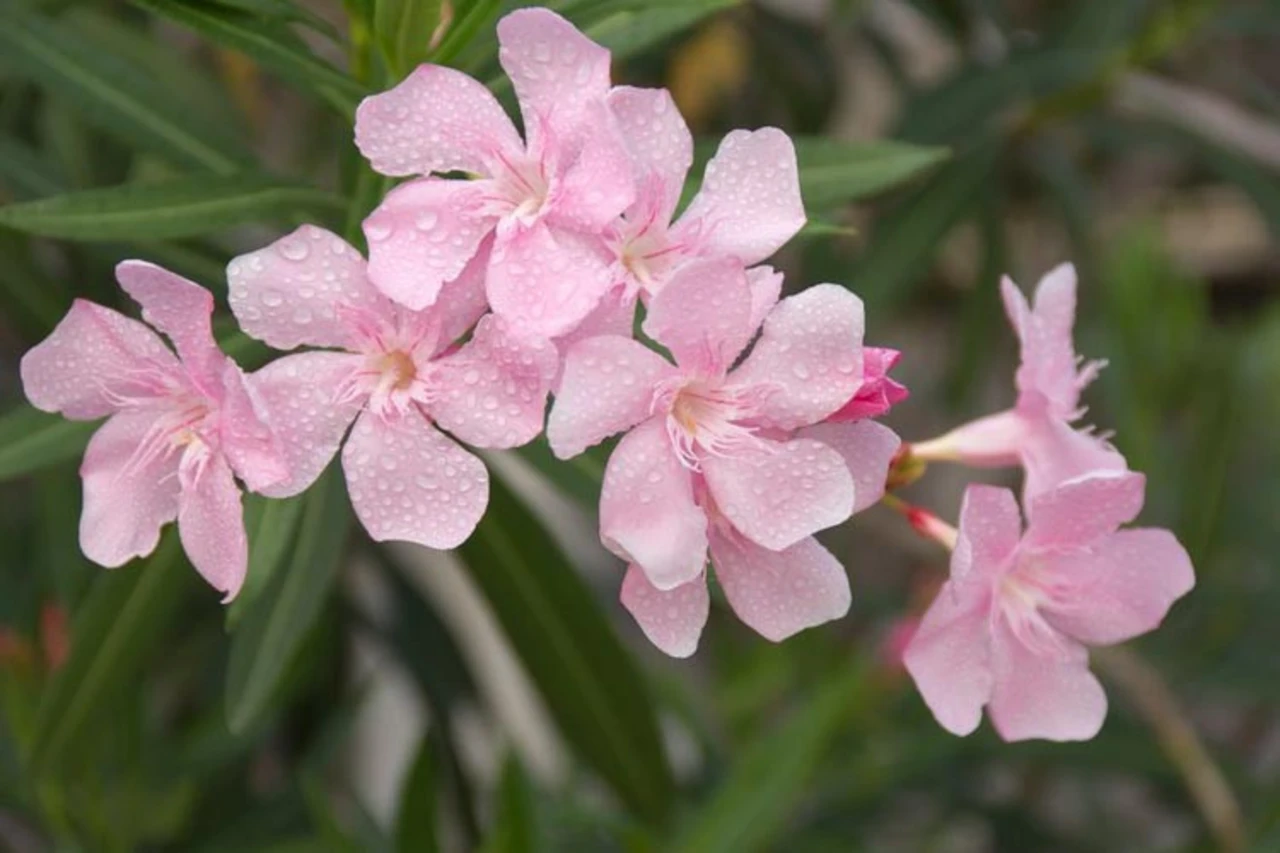
Oleander Nerium oleander is one of those plants people recognise long before they know its name. In summer it can look almost unreal: leathery evergreen leaves, clusters of white, pink, red or apricot flowers, and a calm, ornamental confidence that suits everything from a seaside promenade to a dusty roadside. Yet behind that familiar prettiness sits a reputation that has travelled just as far as the plant itself. Oleander, botanically Nerium oleander, is among the most toxic ornamental shrubs commonly grown around the world.
That contrast is precisely why the plant continues to fascinate. In an age that prizes “pollinator friendly” planting and informal gardens, the oleander remains stubbornly formal, drought-tolerant, and—if you live in the right climate—almost too easy to keep alive. It is also a plant surrounded by half-remembered warnings, internet myths, and genuine public-health concerns, particularly where children or pets might come into contact with it.
This article takes the plant seriously in both senses: as a resilient Mediterranean shrub with real horticultural value in suitable places, and as a potent source of cardiac glycosides that should never be treated casually. If you have searched for “oleander nerium oleander”, the intent is usually practical. People want to know what it is, where it grows, whether it is safe, and how to handle it. The answers are not complicated, but they do require clarity and a bit of botanical context.
What is oleander, and why is it called Nerium oleander?
Oleander belongs to the dogbane family, Apocynaceae, a group that includes plants known for milky sap and chemical defences. Its accepted botanical name is Nerium oleander, though older literature and nursery catalogues sometimes play loosely with naming and varieties. The phrase “oleander nerium oleander” tends to appear in searches because it combines the common and scientific names, and because people are often trying to confirm they have identified the right plant.
In simple terms, oleander is an evergreen shrub or small tree, typically multi-stemmed, that can reach several metres in height in warm climates. It produces narrow, lance-shaped leaves, usually arranged in pairs or whorls, with a tough, almost rubbery feel. Flowers appear in clusters, often over a long season, and are followed by long, slender seed pods that split to release tufted seeds.
It is not a plant of subtlety. It signals “Mediterranean” even when grown far from the Mediterranean. That association is not accidental; the species is believed to be native to parts of the Mediterranean Basin and regions stretching into South-West Asia. Over centuries it has been planted, traded, naturalised and, in some places, become a conspicuous feature of the built environment.
How to recognise oleander in the landscape
Oleander’s popularity means it can turn up where you least expect it: beside motorways, in courtyards, outside hotels, in private gardens, and in public plantings designed to survive heat and neglect. Recognition matters because mistaken identity is common with narrow-leaved evergreen shrubs.
The leaves are one of the clearest clues. They are long and thin, with a prominent central vein, and they tend to sit stiffly rather than drooping. If you snap a leaf or stem you may notice a pale sap. That sap is part of the plant’s defensive arsenal and is one reason the shrub is so unappealing to many browsing animals.
The flowers, when present, are also distinctive. Each flower has five lobes and often looks slightly twisted or pinwheel-like, with a small central corona. Cultivated forms can be single or double, and the colours vary widely. The scent is sometimes noticeable, sometimes absent; it depends on variety and conditions.
Seed pods are another giveaway, though many people never notice them. They are long, narrow follicles that can hang on the plant and later split to release seeds with silky hairs. In windy weather those seeds travel, which contributes to the plant’s ability to naturalise in mild climates.
The habitats it prefers: sun, drainage and a tolerance for hardship
Oleander is, at heart, a plant adapted to sun and periodic drought. In its native range it often grows along riverbeds and seasonal watercourses, where it can access moisture when it is available but survive the long, dry stretches in between. That background helps explain why it performs well in the heat of urban settings, reflecting light off walls and concrete while many shrubs struggle.
In cultivation it tends to thrive in full sun, coping with poor soils so long as drainage is reasonable. It does not enjoy heavy, cold, waterlogged ground. In a British context, that alone rules it out for many garden situations unless it is grown in a container with careful winter protection. In warmer parts of Europe, Australia, South Africa and the southern United States, it is a mainstay precisely because it needs so little attention once established.
It also tolerates salt spray better than many ornamentals, which is why you often see it in coastal towns. The trade-off is that it can look tatty if starved of water during prolonged heatwaves, and it can drop leaves or sulk after unexpected cold snaps. Its reputation for toughness is deserved, but it is not invincible.
A plant shaped by human preference: varieties, colours and the role of breeding
Gardeners usually meet oleander through named cultivars: compact forms for small gardens, larger forms for screening, and varieties bred for flower colour and petal shape. Double-flowered oleanders can look almost rose-like at a distance; single forms are simpler and, to some eyes, more elegant.
Breeding has also focused on floriferousness and habit. In public plantings, predictability matters. Landscape designers want a shrub that holds its shape, flowers for months, and does not demand constant pruning. Oleander fits that brief. It is also evergreen, which makes it useful for year-round structure in climates where deciduous plants leave a bare frame in winter.
But breeding cannot remove the plant’s fundamental chemistry. Whatever the flower colour, Nerium oleander remains toxic. There is no “safe” oleander for households where the risk of ingestion is real.
The toxicity question: what makes oleander dangerous?
It is impossible to write responsibly about oleander nerium oleander without dwelling on toxicity, because this is the issue that most often drives searches and anxiety. The plant contains cardiac glycosides, notably oleandrin and related compounds. These chemicals affect the heart’s electrical conduction and contractility. Ingesting them can cause serious, potentially fatal poisoning in humans and animals.
All parts of the plant are toxic: leaves, flowers, stems, seeds, and sap. Dried material remains dangerous, which matters when people prune shrubs and leave clippings where animals might chew them. There are also repeated warnings about using oleander wood for skewers or cooking fires. The underlying point is simple: heat and drying do not reliably neutralise the toxins.
Symptoms of poisoning can include nausea, vomiting, abdominal pain, dizziness, weakness, irregular heartbeat, and in severe cases collapse. The precise course depends on dose, body size, and individual vulnerability, but the risk is not theoretical. Poisoning cases do occur, and medical care should be sought promptly if ingestion is suspected.
The sap can also irritate skin and eyes. Not everyone reacts, but it is sensible to assume it might. Gardeners handling oleander should treat it as they would a harsh chemical: avoid touching the face, wash hands and tools thoroughly, and be cautious about contact with cuts or sensitive skin.
Children, pets and livestock: why risk is unevenly distributed
Oleander is often discussed as though it poses the same risk in every setting. In reality, risk depends on who is present and how the plant is used.
For most adults, casual contact in a street planting is unlikely to cause harm. The danger rises sharply when children are likely to put plant material in their mouths, when pets chew foliage, or when clippings enter animal feed. Dogs are particularly at risk because some will chew leaves out of boredom; horses and other livestock may be exposed if trimmings are dumped into paddocks.
There is an additional hazard in households that compost garden waste. If oleander clippings are composted and later spread, the toxins do not simply disappear overnight. The risk is not as straightforward as “compost equals poison”, but it does underline the broader principle: plant waste management matters.
Public plantings present a more complex ethical question. Municipalities choose oleander because it is hardy, and because it survives where softer ornamentals fail. Yet placing a highly toxic shrub in spaces where children play or where dogs are walked creates a foreseeable risk. Some local authorities mitigate this with careful siting and signage; others rely on general public knowledge, which is patchy at best.
Myths and misunderstandings: smoke, honey and casual folklore
Oleander attracts a particular kind of folklore. Some of it is grounded in real chemistry; some is embellished into cautionary tales. A common story warns that sleeping near oleander will kill you, or that simply inhaling its scent is dangerous. That is not supported in the way ingestion is. The scent may be strong for some people, and sensitive individuals might find it irritating, but lethal poisoning requires uptake of toxins, typically through eating plant material.
Another recurring claim concerns smoke from burning oleander branches. The prudent advice is not to burn it, because toxic compounds could be inhaled and because ash and residue may remain hazardous. The strength of risk from incidental smoke exposure is not always presented accurately online, but the conclusion remains sensible: do not use oleander as firewood, and keep prunings out of bonfires.
Honey is also mentioned. Bees do visit oleander flowers, but mass poisoning through honey is not a routine feature of public health. The bigger concern is direct ingestion of plant parts or exposure of animals to clippings.
The most damaging misunderstanding is complacency: the belief that because oleander is common, it must be safe. Its ubiquity is a landscape decision, not a toxicological endorsement.
If you grow oleander in the UK: reality versus aspiration
In Britain, oleander occupies an awkward space between aspiration and practicality. People love the Mediterranean look and assume it will behave like a hardy evergreen. Most of the time, the British winter disabuses them.
Oleander can be grown in the UK, but generally as a container plant that is moved under cover when temperatures drop. A sheltered conservatory, frost-free greenhouse, or bright porch can work. Outdoors, it may survive mild winters in very protected coastal or urban microclimates, but survival is not the same as thriving, and a single sharp frost can cause severe damage.
Even where it survives, the plant may struggle to flower well without enough heat and sun. Oleander’s long bloom season is a feature of warm climates. In cooler summers it may produce fewer flowers, or flower late.
There is also a cultural mismatch. British gardens often favour mixed borders, softer textures, and plants that cope with damp. Oleander’s leathery leaves and rigid habit can look out of place unless the garden is designed around a more architectural, dry-climate style. In containers, however, it can function as a focal point, provided the owner accepts the seasonal routine and the toxicity precautions.
Pruning and maintenance: how professionals handle a difficult shrub
Oleander’s maintenance needs are not complicated, but they demand respect. Pruning is usually done to shape the shrub, remove dead wood, and encourage fresh growth and flowering. Because the plant blooms on new growth to some extent, heavy pruning at the wrong time can reduce flowering.
The bigger issue is handling. Professional gardeners typically wear gloves and long sleeves, keep clippings contained, and clean tools. Eye protection is sensible if cutting larger stems that might flick sap. The aim is not theatrical hazard management; it is basic occupational hygiene.
Disposal matters as well. In some places, green waste is processed industrially; in others, households manage it. Either way, oleander should not be left where animals can access it. It should not be chipped casually into mulch for areas where pets roam. If you are uncertain about local disposal rules, that uncertainty itself is a sign to treat the material as potentially harmful waste rather than as ordinary trimmings.
Oleander in ecology: pollinators, pests and what eats it
Oleander is not a sterile, lifeless ornamental. It does interact with wildlife. Pollinators visit its flowers, though the plant’s nectar and chemistry complicate the story. Some insects can exploit it; others avoid it.
One of the most striking examples is the oleander hawk-moth (Daphnis nerii), a large, beautifully patterned moth whose caterpillars feed on oleander and related plants. In warmer regions it can be a notable presence; in Britain it is more often an occasional migrant and a greenhouse visitor. The caterpillars are themselves a reminder of evolutionary arms races: certain insects specialise in plants that are toxic to most others.
As for mammalian browsing, oleander’s toxicity provides strong protection. Deer, goats and cattle tend to avoid it, though hungry animals may still be tempted if little else is available, which is why clippings are so dangerous in drought or scarcity conditions.
The plant can also suffer from pests and diseases, including scale insects and sooty mould, especially when stressed. In humid or poorly ventilated situations, it can look scruffy. Hardiness does not equal immunity, and a shrub that survives neglect may still become unattractive if conditions are wrong.
Oleander and urban planning: why you see it by motorways
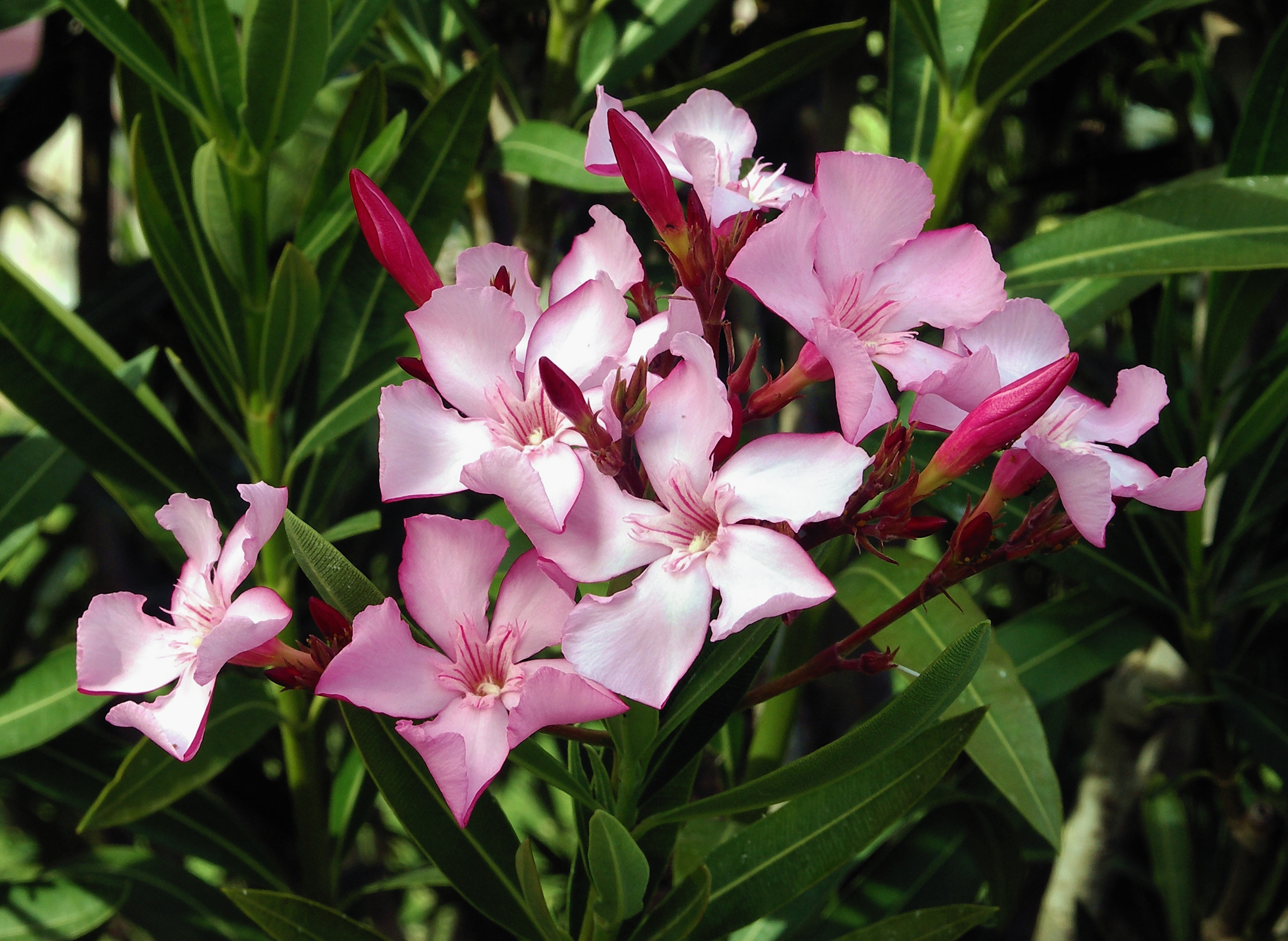
In many hotter regions, Oleander Nerium oleander has become a default choice for road verges and central reservations. The logic is straightforward. It tolerates heat radiating from tarmac, survives intermittent watering, provides a visual barrier, and is less likely to be destroyed by casual damage.
It also has a safety role in some designs, acting as a deterrent to pedestrians crossing busy roads and reducing headlight glare. That is not its botanical purpose, but it is part of its urban story.
Yet planting oleander in public infrastructure raises questions that are increasingly hard to avoid. As cities become more dog-friendly and as awareness of plant toxicity spreads, what was once seen as sensible low-maintenance greenery can begin to look like an avoidable hazard. The counterargument is that many common landscape plants are toxic to some degree. True enough. But oleander’s potency places it at the sharper end of that spectrum.
Urban planning is often a set of compromises between cost, survival, aesthetics and risk. Oleander survives. That is why it keeps being chosen. Whether it should be chosen as often is a different question, and one that depends on context.
Medicine, history and the temptation to treat poison as remedy
Because oleander contains powerful biologically active compounds, it has inevitably attracted medical curiosity and, at times, quackery. Historically, many poisonous plants have been explored for medicinal potential. Digitalis from foxglove is the classic example: a dangerous plant that became a source of cardiac drugs when handled with scientific discipline.
Oleander’s cardiac glycosides have likewise been studied. But the gap between “studied compounds” and “safe home remedy” is enormous. There is no responsible case for self-medicating with oleander preparations. The dose-response curve for cardiac glycosides is unforgiving, and the concentration of toxins in plant material is variable. What is “a little” in a leaf? It is not a meaningful measurement.
From a public-information standpoint, it matters to say this plainly: Nerium oleander is not a DIY medicinal plant. Any suggestion otherwise is not alternative wisdom; it is dangerous misinformation.
Historically, the plant’s reputation has always had this double edge. It has been admired for its beauty and toughness, and feared for its poison. That combination is part of why it appears in literature and anecdote. It is a plant that invites moral lessons, which may be why myths cling to it so easily.
Climate change and shifting horticulture: will oleander become more common?
As European summers become hotter and drier, and as water restrictions become more common, planting choices are changing. Drought-tolerant shrubs are no longer niche. In parts of southern England, gardeners and councils are already experimenting with more Mediterranean and xeric planting palettes.
In that sense, oleander may appear increasingly attractive as a survivor shrub that offers colour in heat. But climate change does not only bring warmth; it brings volatility. Sudden cold snaps, late frosts and extreme weather can still punish tender or borderline-hardy plants. Oleander may become easier to grow in some microclimates while still failing spectacularly in others.
There is also a cultural shift towards biodiversity and native planting. Oleander, as a widely cultivated non-native, does not automatically fit those aims, even if it provides some nectar and shelter. The future of the plant in public and private landscapes may therefore depend as much on ethics and policy as on temperature.
It is possible to imagine a Britain where oleander is more common in coastal towns and sheltered city courtyards. It is also possible to imagine councils avoiding it due to toxicity concerns. Both trends could happen at once.
Living with oleander: a realistic stance for gardeners and the public
Most plant debates become polarised. Oleander is either “deadly and should be banned” or “harmless if you’re not an idiot”. Neither is particularly helpful.
A realistic stance begins with acknowledging what the plant is. Oleander nerium oleander is a tough, handsome shrub with a long flowering season in warm conditions, and with toxins that can cause severe poisoning if ingested. Those facts can coexist.
If you already have oleander in a garden, the sensible approach is to manage risk rather than panic. If there are small children, pets that chew plants, or vulnerable adults, it may not be the right plant for that space. If it is kept, it should be placed where casual contact is limited and where clippings can be controlled.
If you encounter oleander in public places, the key is awareness rather than fear. Do not let children play with the leaves or flowers. Do not allow dogs to chew it. Treat it with the same caution you would give to any clearly labelled hazardous substance, because in biochemical terms that is what it is.
And if you are considering planting it, the question should not be “Is it poisonous?”—it is—but “Is it appropriate here?” That is a judgement that depends on climate, setting, and who uses the space.
Conclusion: an ornamental with consequences
Oleander has survived centuries of cultivation because it does what many plants cannot: it keeps its leaves, shrugs off heat, flowers for long periods and holds its shape in harsh, bright environments. That is why it is planted on roadsides and in courtyards, why it appears in postcards from warm places, and why it still turns heads in midsummer.
But the plant’s success is built partly on chemical defence. Oleander nerium oleander is not merely “a bit toxic”; it is powerfully poisonous, and that reality should shape how it is used and handled. In a world that increasingly asks gardens and public landscapes to be safe, inclusive and ecologically thoughtful, oleander sits at an uncomfortable intersection: beautiful, resilient, and demanding of informed caution.
Understanding it properly does not spoil its beauty. It simply places that beauty in context, which is what any responsible relationship with plants requires.