On a windy day in Penzance, on the harbour walls of Newlyn, or above the crowds at a rugby match in Truro, one flag appears with striking regularity: a white cross set on a field of black. To many visitors it is simply “the Cornish flag”; to many locals it is a marker of belonging, a statement of cultural continuity, and sometimes a quiet challenge to the idea that Cornwall is merely a scenic peninsula at the edge of England. Online, the same curiosity returns again and again, condensed into a straightforward query: cornwall county flag. What is it, where does it come from, and what does it actually represent?
The short answer is that the Cornwall county flag is commonly understood to be St Piran’s Flag, named after the patron saint of Cornwall and closely associated with the region’s mining heritage. The long answer is more interesting, and more revealing. It involves competing historical claims, the revival of Cornish identity in the nineteenth and twentieth centuries, the difference between a county, a duchy and a nation, and the way a simple two-colour design can carry meanings far beyond its fabric.
This article unpacks what the cornwall county flag is, how it became so widely used, what its symbolism suggests, and how it sits among Cornwall’s other emblems.
What people mean when they say “Cornwall county flag”
When someone types cornwall county flag into a search engine, they are usually looking for the black flag with a white cross. In everyday practice, that is the flag most frequently flown to represent Cornwall as a place and as a community, whether on public buildings, private homes, businesses, or at festivals.
Formally, Cornwall is a ceremonial county and a unitary authority area in the United Kingdom, with its own council and a distinct historical identity. But the flag that has come to stand for Cornwall is not a council logo, nor a modern administrative creation. It is a traditional banner rooted in popular usage, which is precisely why it has travelled so widely and been adopted so confidently.
It is worth noting, early on, that Cornwall also has other widely recognised symbols, especially the Duchy of Cornwall’s banner, a black field charged with fifteen gold bezants (coins). That duchy flag is historically significant and visually unmistakable, yet it does not play the same day-to-day role in expressing Cornish identity as St Piran’s Flag does. For most people asking about the cornwall county flag, St Piran’s Flag is the object of interest.
The design: simple, high-contrast, instantly legible
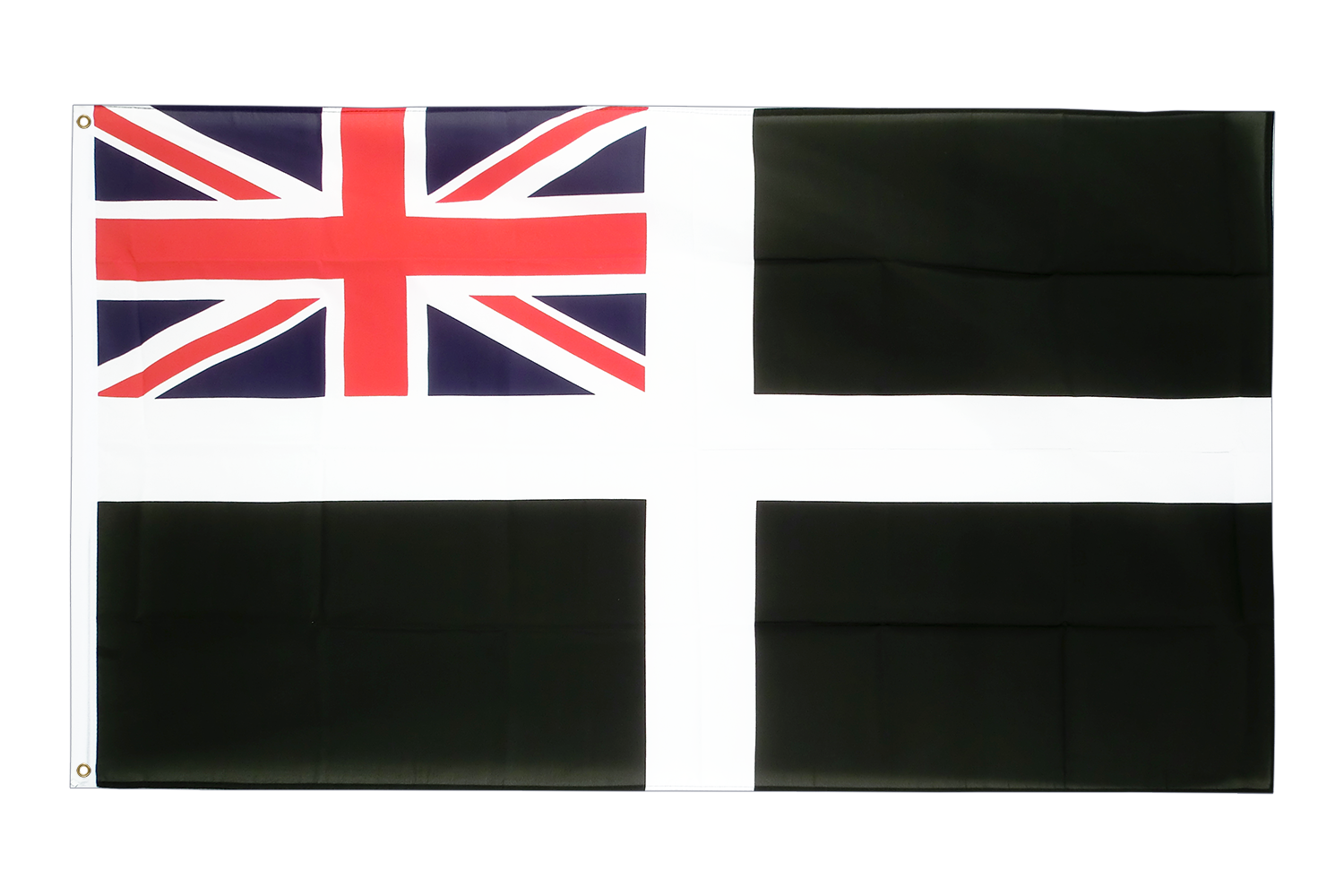
The design of St Piran’s Flag is austere in the best vexillological sense. It is a white cross, usually depicted as a symmetrical “Greek” cross rather than a long-armed Scandinavian cross, placed centrally on a black field. There is no complex heraldry, no text, no coat of arms, no decorative border. The contrast between black and white is stark, and that starkness contributes to the flag’s recognisability at a distance.
Because the design is so simple, small variations are common. The thickness of the cross can differ between manufacturers and between handmade versions. The exact shade of black may range from deep charcoal to a slightly lighter tone depending on fabric and light. Yet these differences rarely matter in practice; the flag’s identity is carried by the basic geometry and the two-colour scheme.
This simplicity is not accidental in how it functions culturally. A flag that is easy to draw, reproduce and remember tends to spread. It can be painted on a wall, stitched by hand, printed on a scarf, or improvised at a protest. The cornwall county flag, as most people encounter it, thrives in part because it is uncomplicated.
St Piran and the mining legend behind the colours
St Piran (or Piran) is traditionally regarded as the patron saint of Cornwall and, more specifically, of tin miners. The story most often retold to explain the flag’s symbolism connects directly to tin smelting: the black field represents the dark ore or the blackened furnace, and the white cross represents the stream of tin emerging, or the purity of the metal revealed by fire.
Like many saintly legends, the narrative exists in multiple versions and is difficult to date with precision. Some accounts describe St Piran discovering tin by accident when his hearthstone, heated by fire, released a white streak of metal. Others frame it as a divine sign, transforming an everyday act into a revelation.
Whether historically literal or not, the legend is important because it ties the flag to an industry that shaped Cornwall’s landscape, economy and social structure for centuries. Mines, engine houses, spoil tips and industrial harbours remain visible reminders of a period when Cornwall was not a peripheral tourist destination but a place with global industrial connections. Cornish miners travelled the world, and their expertise in hard rock mining influenced communities from the Americas to Australia and South Africa. In that sense, the cornwall county flag carries not only local meaning but echoes of a global diaspora.
How old is the flag? Between tradition and modern adoption
One of the most common points of confusion around the cornwall county flag is its age. You will sometimes see claims that it dates back to the early Middle Ages, or even earlier, and that it has been flown for a thousand years. You will also see more cautious scholarship suggesting that its widespread adoption is much more recent, particularly from the nineteenth century onward.
The truth lies in the messy space between. Cornwall has a long Christian history, and saints’ cults and local religious traditions are old. But evidence for a specific black-and-white cross flag in early medieval Cornwall is limited. Many historians and flag scholars treat St Piran’s Flag as a relatively modern symbol that drew upon older religious and mining associations but became prominent as part of a wider cultural revival.
In the nineteenth century, Cornwall experienced deep economic and social change. Mining declined in many areas, migration increased, and the region’s distinctiveness was increasingly defined in relation to a centralising British state. At the same time, there was a growing interest across Europe in folklore, local history and “national” traditions. In Cornwall, this contributed to the emergence of a modern Cornish consciousness that drew on language, literature and symbols.
Flags are particularly useful in these moments. They compress identity into a visible marker. They can be displayed without a speech. They can unify disparate communities behind a shared sign. St Piran’s Flag fits that role remarkably well: it is meaningful without being complicated, local without being parochial, and historic in tone even if its public prominence is modern.
Cornwall, county and nation: why the wording matters
Calling it the cornwall county flag may sound straightforward, but it brings its own ambiguities. Cornwall is a county in administrative terms, yet many Cornish people regard it as more than that: a nation, a distinct cultural region, or one of the Celtic countries, alongside Wales, Scotland, Ireland, Brittany and the Isle of Man. That perspective is expressed through language revival efforts, cultural festivals and political movements of varying intensity.
The flag sits at the intersection of those views. For someone who sees Cornwall primarily as a county, the flag is comparable to other county flags: a regional emblem, flown at local events or by county teams. For someone who sees Cornwall as a nation, the flag carries a stronger charge, closer to a national banner than a county standard.
This does not mean the flag always functions as a political statement. Often it is simply cultural. But its flexibility is part of its power. The same cloth can be flown to celebrate a village fête, to mourn a local tragedy, to mark St Piran’s Day, or to signal a political demand. The cornwall county flag, in other words, is not a static object. Its meaning changes with context.
St Piran’s Day and the flag’s place in the calendar
If there is a single moment when the cornwall county flag becomes impossible to miss, it is around 5 March, St Piran’s Day. Celebrations vary from place to place, but they often include parades, music, community gatherings and displays of Cornish symbols.
The day illustrates how a flag can work as social glue. People who disagree on politics, or who come from different parts of the county, can still rally around the same emblem for a day of shared recognition. In a region where identity can be intensely felt but unevenly expressed, St Piran’s Day functions as an annual focal point, and the flag is the most visible shorthand for it.
It also shows the changing role of local traditions in modern Britain. Some see such celebrations as a healthy expression of regional culture. Others worry about exclusivity or about identity being used as a wedge. The flag’s widespread presence on St Piran’s Day does not settle those debates, but it demonstrates that the symbol is alive and socially embedded rather than museum-bound.
Recognition and “official” status: what is actually recognised?
People asking about the cornwall county flag often want to know whether it is “official”. The question seems simple, yet in the UK there is no single legal mechanism that makes a flag official in the way some constitutions might. Flags exist across overlapping systems: historic tradition, civic usage, registry recognition, and, in some cases, government protocol.
St Piran’s Flag is widely accepted as the flag of Cornwall in common usage. It has also been recognised and catalogued by respected flag institutions in the UK, which matters because it provides a form of standardisation and public acknowledgement. Such recognition does not necessarily create legal rights, but it does signal that the flag is not merely an internet meme or a private invention; it is a widely established emblem with a documented place in British and regional flag culture.
At the level of local government, Cornwall Council has its own branding and logos, which are not the same thing as the county flag. Councils typically use corporate marks for administrative purposes rather than traditional flags, though they may fly St Piran’s Flag on certain occasions or alongside other flags. This coexistence can confuse observers: a council logo is an institutional identifier; the cornwall county flag is a cultural symbol used by the public and, at times, by institutions.
The Duchy of Cornwall flag: a separate emblem with a different meaning
Any serious look at the cornwall county flag needs to address the duchy banner: black with fifteen gold discs, known as bezants. This flag is associated with the Duchy of Cornwall, a historic estate and title held by the heir apparent to the British throne. The duchy is a significant landowner and economic actor, and its symbolism reaches back into medieval heraldry.
The duchy flag is sometimes mistaken for the “real” Cornish flag by those encountering it for the first time, especially because its black field visually echoes St Piran’s Flag. But the messages conveyed are distinct. The duchy emblem is tied to a constitutional and feudal history, to land, rights and revenue. St Piran’s Flag is tied to a saint, to mining, and to popular identity.
Both are Cornish symbols, but they do not speak for the same thing. One is an emblem of a duchy; the other functions as a flag of a people and a place. That difference matters when interpreting displays. A building flying the duchy banner may be signalling an institutional link to the duchy. A fishing boat flying St Piran’s Flag is more likely signalling local belonging.
The flag in sport: identity at full volume
Sport is one of the arenas where flags do their most visible work. At matches, symbols become louder and more explicit. In Cornwall, rugby has long been an especially important stage for expressing regional identity, and St Piran’s Flag has become part of that spectacle.
In sporting contexts, the cornwall county flag often plays a dual role. It supports a team, but it also frames the team as representing Cornwall’s distinctiveness. This is not unique; many regions use sport as a vehicle for identity. The difference is that Cornwall’s identity sometimes sits uneasily within English sporting structures, which makes the flag more than just a cheerleading prop.
At the same time, it is easy to over-politicise what many supporters experience as simple pride. People fly the flag because it feels like home, because it looks good in a crowd, because it connects them to family history, because it marks an occasion. The same flag can be both ordinary and charged.
The Cornish diaspora and the flag abroad
Cornish migration has been substantial, especially during periods of industrial decline. Cornish communities formed in mining regions overseas, where their skills were in demand. Over time, those communities developed their own traditions and kept links to Cornwall through family, food, religious practices and cultural organisations.
In that context, St Piran’s Flag has travelled. It appears at diaspora gatherings, on social media groups, in heritage events and, sometimes, in the décor of pubs and community centres with Cornish connections. For people whose relationship to Cornwall is mediated through grandparents’ stories or a long-distance sense of origin, the cornwall county flag provides an accessible badge of ancestry.
This phenomenon is not always straightforward. Heritage can be embraced sincerely, but it can also become stylised or simplified when it is distant. A flag can flatten a complex history into a neat icon. Yet its very portability is why it works. For a diaspora, a flag is a way to carry home without having to explain it.
Symbols and misunderstandings: what the flag is not
Because the flag is black-and-white and cross-shaped, it can be misread by those unfamiliar with its context. Crosses appear in many flags; black-and-white can be used for many causes. The Cornish flag is not a general sign of protest, nor a symbol of mourning, nor a derivative of any particular contemporary movement. Its meaning is local and historically grounded, even if people may repurpose it in new contexts.
It is also not a religious banner in the sense of being confined to church use. The cross is part of its design, and the name references a saint, but its modern use is overwhelmingly cultural rather than devotional. Many people who fly it are not doing so as an act of religious piety. They are signalling Cornishness.
Another misunderstanding concerns exclusivity. Some critics treat regional flags as inherently exclusionary, as if they necessarily define who belongs and who does not. In practice, St Piran’s Flag is used in many inclusive settings, including by people who moved to Cornwall and embraced it. Symbols can be used to exclude, but they can also be used to invite. The flag does not dictate the ethics of its use; communities do.
The Cornish language revival and the flag’s role as a companion symbol
Cornish, a Celtic language closely related to Breton and Welsh, experienced a period of decline and later revival. Today, Cornish appears on signage, in ceremonies and in educational contexts, though it remains a minority language.
Flags and language revivals often travel together because both serve as visible markers of distinct identity. A bilingual road sign may be read as a political statement by some and a cultural celebration by others. The same is true of the cornwall county flag. You may see the flag alongside Cornish words such as “Kernow”, the Cornish name for Cornwall, further reinforcing the idea that the region has its own cultural infrastructure.
This pairing matters because it shows the flag is not an isolated token. It sits within a broader ecosystem of symbols: music, dance, food traditions, festivals, and historical narratives. In that ecosystem, the flag is the easiest to display, which is why it often becomes the first symbol outsiders recognise.
A flag in the landscape: from engine houses to beaches
Cornwall’s landscape is part of the flag’s emotional resonance. The black-and-white design fits the county’s visual contrasts: dark cliffs and pale surf, slate and sand, storm and sunlight. That is a poetic reading, of course, but it helps explain why the flag feels “right” to many people. Symbols gain strength when they feel visually at home.
The mining heritage provides an even more concrete landscape link. Ruined engine houses on cliffs are among Cornwall’s most iconic sights. They are often photographed with the sea behind them, and they embody a particular kind of industrial romanticism. In such places, St Piran’s Flag can feel like a banner of memory as much as identity: a sign that Cornwall’s story includes labour, hardship and technical skill, not only tourism.
This matters because the cornwall county flag is sometimes dismissed by outsiders as a decorative souvenir. In reality, it is tied to deep economic history. The black can be read as the darkness of mines; the white as metal, light, or revelation. However one interprets it, the symbolism does not float free of the ground.
The flag and politics: autonomy, recognition, and caution
Cornwall has long had movements advocating for greater recognition, whether cultural, administrative or political. Some seek more devolved powers for Cornwall; others emphasise legal or constitutional recognition of Cornwall’s distinct status; others focus on practical matters such as funding and regional decision-making.
The flag appears in these contexts because political movements need symbols. But it would be a mistake to reduce the cornwall county flag to a partisan marker. Many people who fly it have no interest in constitutional change. They may simply want Cornwall to be respected as distinct, or they may just enjoy the cultural expression.
Still, symbols can become contested when they are used in political campaigns. A flag that is broadly loved can become a battlefield if it is claimed by one group as “theirs” alone. The healthiest cultural symbols tend to remain open: available to those who live in the place, those who have roots there, and those who participate in its life. St Piran’s Flag has largely retained that openness, though tensions occasionally surface, especially when debates about housing, tourism, and local services sharpen the question of who Cornwall is for.
Etiquette and practical use: how the flag is typically flown
There is no single universal etiquette for the cornwall county flag beyond general flag-flying customs. In practice, you will see it flown alone, alongside the Union Flag, or alongside the flag of England, particularly at public events. You may also see it with the European flag in certain historical contexts, though that has become less common since Brexit.
On some buildings, St Piran’s Flag is raised on specific days such as St Piran’s Day, or during local festivals. On others, it may fly year-round as an expression of identity. This range of practice reflects the fact that the flag is primarily cultural rather than strictly ceremonial.
Because it is so widely used on merchandise, the design also appears in contexts far removed from formal flagpoles: stickers on cars, boat flags, clothing. Purists sometimes dislike such uses, arguing that the flag should be treated with more dignity. Others see them as proof the symbol is alive and belonging is everyday.
Why this flag, and not another?
Cornwall has other symbols that could theoretically have become dominant: the duchy bezants, local coats of arms, heraldic devices, even modern graphic designs. Yet St Piran’s Flag has become the default answer to cornwall county flag for a reason.
It is visually powerful, easy to reproduce, and rooted in a story that connects place, labour and tradition. It is not tied to a single institution. It does not require specialist knowledge to recognise. And it avoids some of the baggage associated with other symbols, particularly those linked to feudal structures or elite ownership.
Perhaps most importantly, it is a symbol that ordinary people can claim without permission. That is not a small point. Many regional identities become entangled with officialdom in ways that alienate people. St Piran’s Flag is, in essence, a public flag: it belongs to the community because the community uses it.
Conclusion: a county flag that functions as a cultural flag
The phrase cornwall county flag points to a simple image, but behind that image sits a complex story: of saints and smelters, of modern revivals and ancient claims, of county administration and national feeling, of diaspora memory and local belonging. St Piran’s black field and white cross have become Cornwall’s most widely recognised emblem not because a law imposed it, but because a population adopted it.
In the end, the flag’s importance is not settled by arguments about exact dates of origin or by institutional definitions. It is settled by practice. The cornwall county flag endures because it continues to be flown, year after year, in streets and on cliffs, at celebrations and in everyday life, as a concise way of saying that Cornwall is not just a location on a map but a place with its own voice and continuity.